


The best places to buy vegan combat boots online are brand-direct sites like Unikiff for cruelty-free, bold-print designs, vegan-only marketplaces and sustainable retailers for curated selection, and large marketplaces or resale platforms when you want variety or a lower price. Always check the material breakdown and return window before you check out.
TL;DR:
- Buying directly from brand sites provides the most detailed material information, exclusive designs, and better customer support for fit questions.
- Vegan retailers and marketplaces curate animal-free options, streamlining research, while sustainable brands incorporate broader ethical standards, including labor and recycling.
- Look for bio-based materials like polyurethane or recycled content, and choose construction methods like Goodyear welt for resoling and longer lifespan.
- Verify material specifics, sole type, manufacturing country, and return policy on product pages to avoid low-quality or misleading listings.
- Budget boots under $80 often feature glued soles and basic materials, while premium options exceeding $150 typically offer better durability and resoling potential.
Table of Contents
- Where To Buy Vegan Combat Boots Online: Your Best Channels
- How Do You Choose the Right Vegan Combat Boots?
- How Do You Find Your Perfect Vegan Combat Boot Size?
- How Do You Clean and Maintain Vegan Combat Boots?
- What Red Flags Mean a “Vegan” Boot Listing Isn’t Trustworthy?
- What Do Vegan Combat Boots Typically Cost, and What About Shipping and Returns?
- How Long Does Shipping Take for Vegan Combat Boots?
- What’s the Full Cost Breakdown, Including Taxes and Import Fees?
- Why Brand-Direct Cruelty-Free Sellers Are Often the Smarter Buy
- Get Your Next Pair From Unikiff
- Sources
Where To Buy Vegan Combat Boots Online: Your Best Channels
Every channel selling vegan combat boots online serves a different shopper, and knowing the difference saves you from a bad return experience.
Brand-direct sites give you the deepest information. When you buy straight from a brand like Unikiff, you get full access to size guides, exact material specs, and unique printed designs you won’t find anywhere else. Direct-to-consumer sellers also tend to answer fit questions faster since they’re not juggling a third-party return process.
Vegan-only retailers and marketplaces curate collections specifically screened for animal-free materials, which cuts down your research time. These sites exist because “vegan” claims get murky elsewhere, so a dedicated vegan retailer is doing some of the vetting for you.
Sustainable fashion retailers cast a wider ethical net, filtering for certifications, recycled content, and labor practices alongside vegan status. If you care about the full supply chain, not just the leather substitute, this is where to look.
Large general marketplaces carry the widest selection and often the lowest prices, but material claims are less consistently checked. Read the actual product description, not just the “vegan” tag, and scan reviews for fit and durability complaints before buying.
Resale and secondhand platforms are worth checking for discontinued prints or premium constructions at a fraction of retail. The tradeoff is condition risk. Ask sellers for close-up photos of the soles and stitching, and confirm the platform’s buyer protection before paying.
- Brand-direct: best transparency, sizing help, exclusive designs
- Vegan-only marketplaces: pre-screened, saves research time
- Sustainable retailers: broader ethical filtering and certifications
- Large marketplaces: widest selection, verify materials yourself
- Resale/secondhand: rare finds and lower prices, inspect condition first
Editorial roundups confirm there’s genuine depth in this market now. The Vegan Word’s list of top vegan combat boots shows styles ranging from budget canvas builds to fully stitched leather-alternative constructions, so you’re not settling for one look or one price point.
How Do You Choose the Right Vegan Combat Boots?
Getting this right comes down to five checks, in this order of importance.
- Material first. Look for bio-based leathers or polyurethane (PU), ideally with recycled content. Avoid PVC-heavy uppers where you can. Greenpeace’s report on PVC outlines the environmental and health concerns tied to PVC production and disposal, which is why most sustainability-minded brands have moved away from it.
- Construction second. A Goodyear-welted or stitch-down boot costs more upfront but can be resoled instead of thrown out. Thorogood’s explainer on Goodyear welt construction breaks down why this stitching method outlasts glued soles by a wide margin.
- Sole type third. City wear needs grip and flex. Festival use needs support for long hours standing. Wet climates need a genuinely sealed sole, not just a “water-resistant” label.
- Comfort and lining fourth. Breathable linings matter more than they sound. A sweaty boot after six hours at a festival is a real problem.
- Price against construction fifth. A glued $40 boot and a welted $150 boot are not competing products. They’re solving different problems.
Before you buy anything, check the product page for these four answers: exact material name (not “man-made material”), sole composition, country of manufacture, and the return window length.
Pro Tip: Zoom in on product photos of the sole edge. A visible stitched welt line means resoling is possible down the road; a smooth glued seam means the boot is disposable once the sole wears out.
How Do You Find Your Perfect Vegan Combat Boot Size?
Sizing mistakes are the number one reason people return boots, and it’s almost always avoidable.
Measure your foot length and width at the end of the day, when feet are slightly swollen, and compare against the brand’s actual chart rather than guessing from your usual shoe size. Every brand fits differently. A boot with a narrow toe box will feel completely different from a roomier design in the same labeled size.
- Check for brand-specific fit notes (“runs narrow,” “true to size,” “order half a size up”)
- Confirm the return window and whether return shipping is free before you buy
- Factor in sock thickness if you’re planning festival or winter wear
- Expect a short break-in period for any new stitched boot, vegan or not
Unikiff’s size guide walks through measuring at home so you land on the right fit the first time, instead of paying return shipping twice.
How Do You Clean and Maintain Vegan Combat Boots?
Vegan leather and vegan suede need different care, and treating them the same shortens their life.
For vegan leather, wipe down with a soft cloth and warm soapy water, then air dry away from direct heat. For vegan suede, use a soft brush once the material is fully dry, never wet. Skip the washing machine entirely.
- Apply a synthetic-safe waterproofing spray every few months, especially before wet-weather wear
- Store boots upright with boot shapers or rolled paper to hold their form
- Deodorize with a light baking soda treatment if needed between wears
- If you bought a Goodyear-welted pair, ask a cobbler about resoling before the upper gives out
Resoling isn’t just an eco-friendly habit. Thorogood’s own construction guide notes that a welted boot can go through multiple resoles over its lifespan, which changes the math on a $150 pair versus a $40 pair you’ll replace three times.
What Red Flags Mean a “Vegan” Boot Listing Isn’t Trustworthy?
A few warning signs separate a legitimate vegan boot from a listing that’s cutting corners or hiding something.
Vague phrasing like “man-made material” with no further detail is the biggest one. Real vegan brands name their materials, whether it’s PU, microfiber, or a specific bio-based leather. No stated return policy, or a return window under 14 days, suggests the seller expects complaints they’d rather not deal with. Extremely low prices paired with claims of “premium stitched construction” almost never add up. A missing country of manufacture or missing sole composition on the product page usually means the seller doesn’t want you to ask more questions.
- No specific material name listed anywhere on the page
- Return window shorter than two weeks or no return policy at all
- Price that doesn’t match the claimed construction quality
- Sole composition or country of manufacture left out entirely
What Do Vegan Combat Boots Typically Cost, and What About Shipping and Returns?
Price ranges track construction quality closely, so it pays to know which tier you’re actually shopping in.
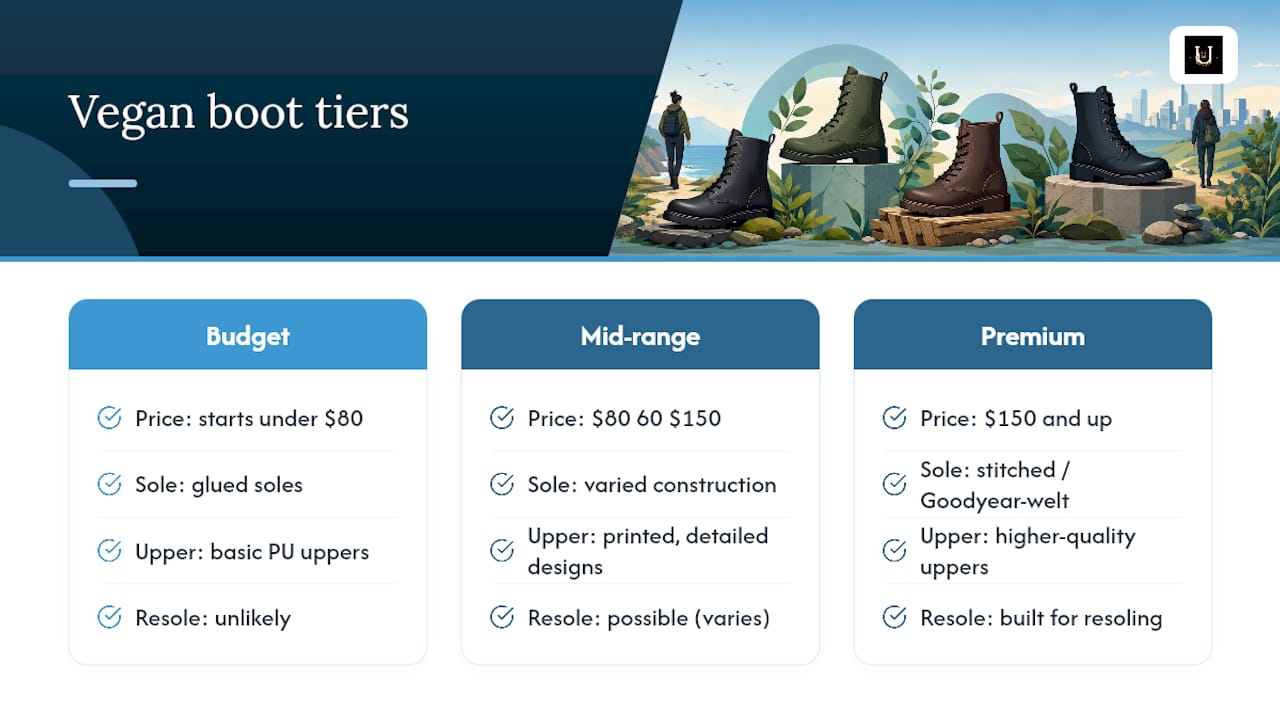
Budget mass-market vegan combat boots typically start at fairly low prices, usually featuring glued soles and basic PU uppers. Mid-range brand-direct options, including printed and detailed designs, generally run $80 to $150. Premium stitched or Goodyear-welted vegan boots, built for resoling and long-term wear, sit at $150 and up. Retailer pricing patterns across the category show this same spread, confirming that construction, not just branding, drives most of the price difference.
Shipping practices vary more than you’d expect. Many EU-based and direct-to-consumer vegan brands offer free shipping past a minimum order threshold, alongside a defined returns window, often 14 to 30 days. Product and shipping details from EU vegan retailers illustrate this pattern clearly: material disclosure paired with a clear returns policy tends to go hand in hand with a more trustworthy seller.
Before buying, always confirm three things: whether return shipping is free or comes out of your pocket, whether the window starts at order date or delivery date, and whether exchanges (versus refunds only) are offered for sizing issues. A generous returns policy is often a better signal of seller confidence than any marketing claim on the page.
How Long Does Shipping Take for Vegan Combat Boots?
Delivery timelines depend heavily on where the brand manufactures and ships from, and this is worth checking before you order for a specific event.
Domestic orders from brands that stock inventory locally typically arrive in 3 to 7 business days. Made-to-order boots, common among smaller ethical brands producing in smaller batches, usually take longer: often 1 to 3 weeks for production alone, plus shipping time on top. International orders shipped from EU manufacturers to buyers overseas can take anywhere from 1 to 4 weeks depending on customs processing in the destination country.
If you need boots by a specific date (a festival, a trip, a gift), check the listed processing time separately from the shipping estimate. Made-to-order items list these separately for a reason, and combining them gives you a much more realistic delivery window than the shipping estimate alone. When in doubt, message the seller directly and ask for a current estimate. Processing times shift with demand, especially around seasonal spikes.
What’s the Full Cost Breakdown, Including Taxes and Import Fees?
The sticker price on a product page is rarely the full cost, especially when you’re ordering across borders.
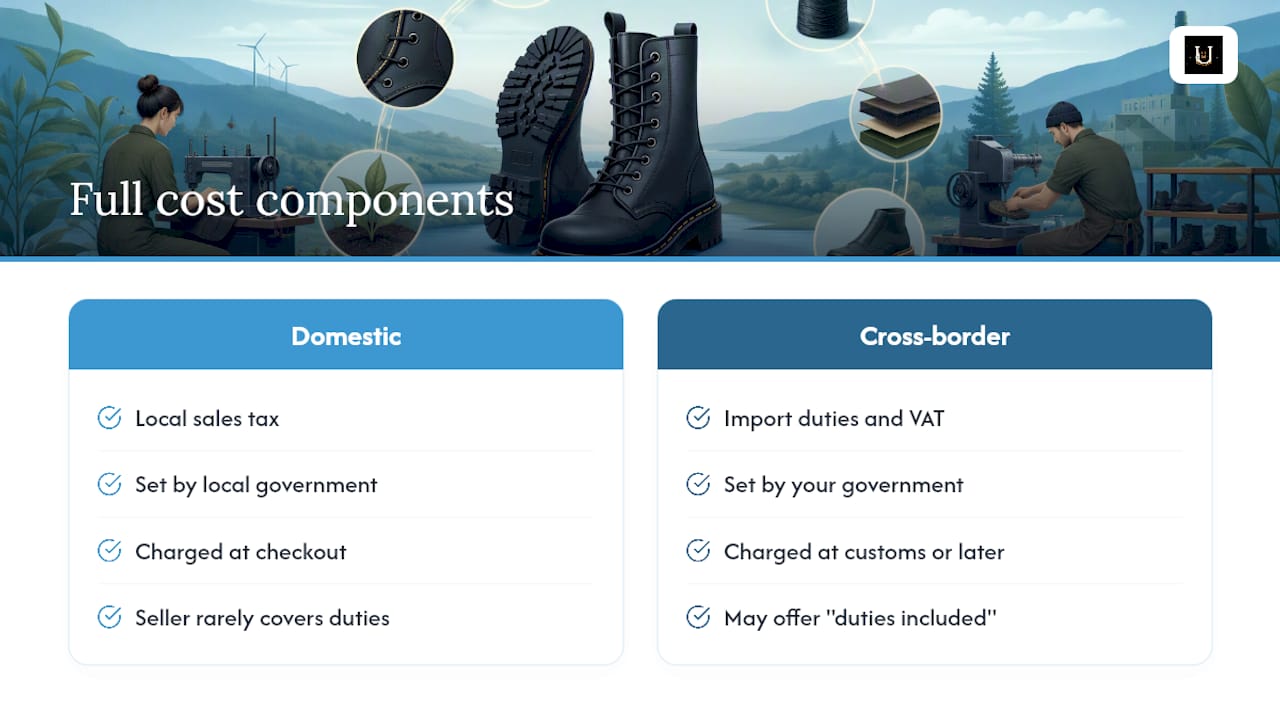
Domestic orders within your own country typically only add local sales tax, if your state or region charges one at checkout. Cross-border orders are where costs get less predictable. If you’re ordering from a manufacturer based outside your country, you may owe import duties and value-added tax (VAT) or a local equivalent, calculated on the item’s declared value once it crosses customs. These fees vary by country and are set by your own government, not the seller, so check your country’s customs threshold before ordering internationally.
Some brands build duties into the checkout price (known as “landed cost” or “duties paid” shipping), which means what you pay at checkout is the final cost. Others ship duties-unpaid, meaning a customs bill can arrive separately after delivery. This distinction matters enough that it’s worth checking at checkout, not after your boots ship. Look for language like “duties included” or “all taxes paid” near the shipping options, and if it’s unclear, ask before you order.
Why Brand-Direct Cruelty-Free Sellers Are Often the Smarter Buy
Buying direct from a cruelty-free maker isn’t just a values choice. It’s usually the more practical one, too.
When you buy from a brand-direct source, you’re getting a size guide built specifically for that brand’s own last shape, real customer support if a boot doesn’t fit right, and access to designs you won’t find duplicated across ten different marketplace listings. That combination matters more than people give it credit for. A gothic skull print or a cottagecore floral design isn’t something a generalist marketplace curates well. It’s something a brand with a specific point of view designs on purpose.
The durability question isn’t separate from the style question, either. A boot built to hold up through festivals and daily city wear needs the same reinforced ankle structure and grippy sole regardless of whether it’s got a bold print or a plain black finish. If you’re unsure about fit, check a brand’s size guide before ordering and don’t hesitate to reach out to customer support with specific measurements. That one message can save you a return.
— David
Get Your Next Pair From Unikiff
Unikiff skips the guesswork of scrolling ten marketplace listings hoping the “vegan leather” tag is accurate. Every pair is made-to-order using cruelty-free materials, with full size support and prints you won’t find duplicated across generic retailers, from gothic skull motifs to cottagecore florals.
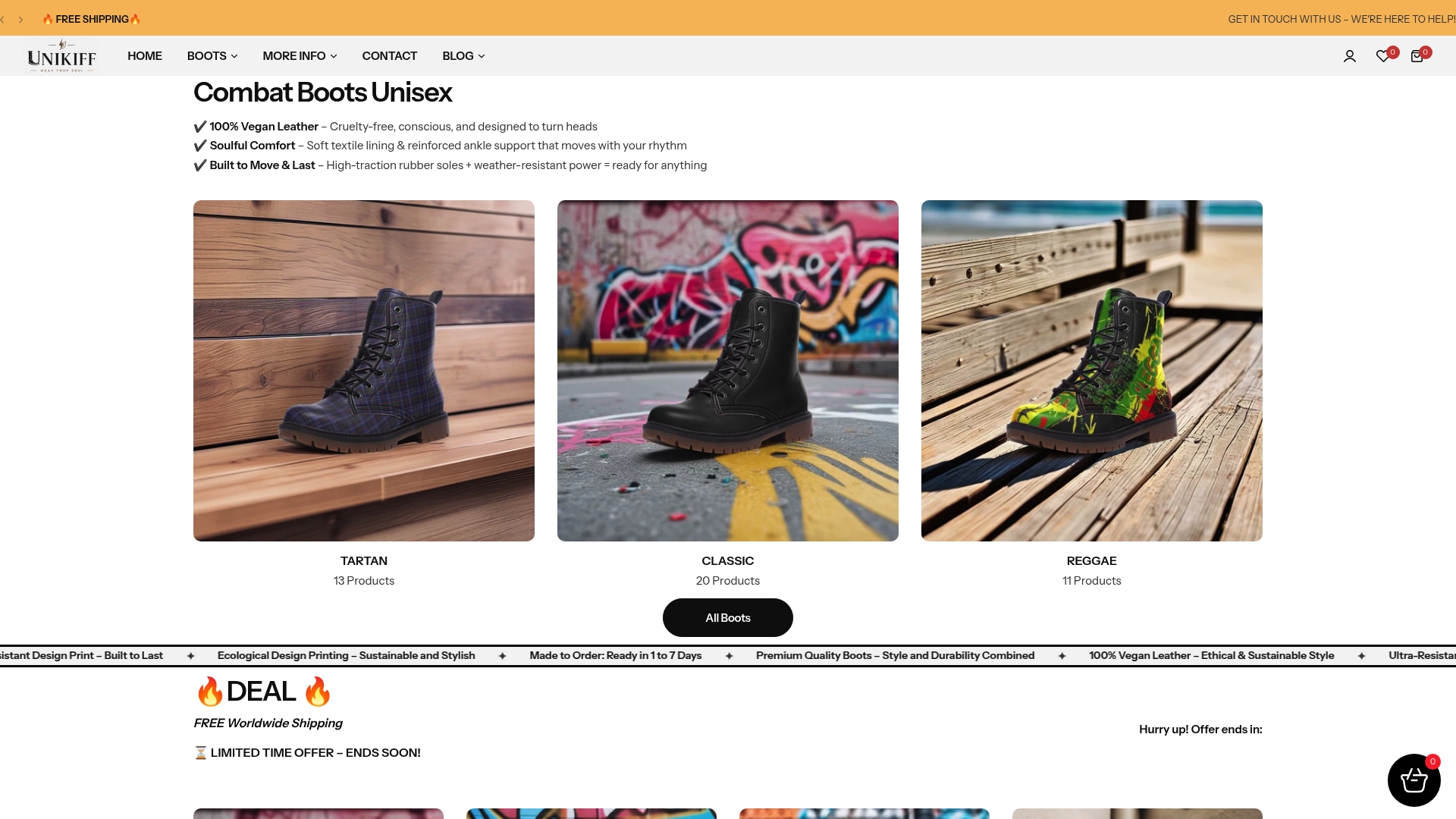
If you’ve been eyeing something with real personality, browse the Vegan Combat Boots collection and check out standout designs like the Skull and Roses boots or the Dark Purple pair for a sense of the range. Before you order, run your measurements against the size guide so your first pair fits right the first time. No returns, no back-and-forth, just boots that match your style from the start.
Sources
- PVC: The poison plastic — Greenpeace (USA)
- Goodyear welt — Thorogood USA
- The 12 Best Vegan Combat Boots to Rock This Year — The Vegan Word