


Martens vegan boots](https://pricespy.co.uk/s/dr-martens-vegan-boots/). A materials study shows why: bio-based alternatives cost more to make. Your best move? Watch for sales or go straight to a specialist direct-to-consumer brand with a clear size guide, since that cuts your return risk fast.
TL;DR:
- Budget vegan boots under $100 generally use basic synthetic materials and have limited warranties, making them less durable for daily wear.
- Mid-range options between $100 and $200 typically feature better construction, reinforced soles, and standard return policies, offering improved value.
- Bio-based materials like Piñatex or Desserto command a higher price but do not automatically provide longer-lasting durability compared to cheaper synthetics.
- Sales, coupons, and careful sizing checks during purchase can significantly reduce the total cost, especially for mid-range and premium boots.
- Shipping costs, taxes, and delivery times vary by region and retailer, affecting the final price and timing beyond the listed product price.
Table of Contents
- What you can expect to pay: budget, mid-range, and premium explained
- Style and material: which boot types cost more and why
- Best channels and practical tactics to lower the price you pay
- Quick checklist to compare price vs. real value
- Unikiff: how the brand fits price-conscious and value-seeking buyers
- Average total cost including taxes and shipping for online purchases
- Timeline for delivery after purchase
- Author’s short take: budget buys vs. investment pairs
- Unikiff collections and next steps
- Sources
- FAQ
What you can expect to pay: budget, mid-range, and premium explained
Vegan boots fall into three price bands, and each one buys you something different.
Budget vegan boots typically sit under $100. These usually use basic synthetic materials like PVC or PUR, simpler construction, and limited return windows. You’ll find them on handmade marketplaces and mass-market retailers running clearance deals.
Mid-range pairs run from $100 to $200. This is where you get better stitching, reinforced soles, and often a real returns policy instead of a store-credit-only deal. Retail listings tracked for Dr. Martens vegan boots show this band covers a wide chunk of mainstream vegan footwear.
Premium and designer boots go above $200. Designer collaborations have priced vegan shoes between £180 and £230 for limited runs, as reported in coverage of the Uggs x Collina Strada collection. You’re paying for brand name and exclusivity here, not necessarily longer-lasting boots.
Here’s how the bands usually shake out:
- Under $100: Basic synthetics, simpler stitching, shorter or no warranty.
- $100 to $200: Better materials, reinforced construction, standard 30-day returns common.
- Above $200: Designer collaborations, bio-based materials, limited-run pricing.
Sales shift boots between these bands constantly. A $180 mid-range pair can drop to budget territory during a seasonal sale, while a limited colorway can push an otherwise mid-range boot into premium pricing overnight. Watch listings around major shopping seasons if you want to catch a boot moving down a band.
Style and material: which boot types cost more and why
The style you pick changes your price target as much as the brand does.
Combat boots tend to sit in the budget-to-mid range because the construction is straightforward: a sturdy sole, lace-up shaft, and minimal hardware. Ankle and Chelsea styles price similarly, though slip-on construction sometimes costs less to produce. Winter-insulated boots cost more across the board since they need extra lining and waterproofing. Fashion or designer boots carry the highest prices, often for brand recognition rather than material superiority.
Material choice matters just as much as style:
- Basic synthetics (PVC, PUR) keep costs down but wear out faster and breathe less.
- Premium engineered synthetics cost more and usually last longer with better flex.
- Bio-based alternatives like Piñatex, Desserto, and mushroom leathers command a price premium tied to newer manufacturing and smaller production runs.
A materials-comparison study found that no current leather alternative matches the universal performance of animal leather across every property tested, as explained in this cruelty-free nagels uitgelegd guide. The coatings research from MDPI compared leather, artificial leather, and nine plant-based alternatives across mechanical strength, water vapor permeability, and water absorption. Some bio-based options scored well on individual properties but traded off durability elsewhere, which is exactly why they cost more without automatically outlasting cheaper synthetics. The same research flagged that some products labeled “vegan” turned out to be composite materials layered with leather board, so a higher price tag doesn’t always guarantee a fully animal-free product.
Best channels and practical tactics to lower the price you pay
Where you shop changes your price as much as what you buy.
Marketplaces offer the widest range but the least quality control. Retailer sales are reliable for mid-range brands cutting prices seasonally. Indie and specialist shops often price fairly for what you get, especially direct-to-consumer vegan brands. Resale and secondhand sites can undercut every other channel, though sizing risk goes up.
A few tactics stretch your budget further:
- Time your purchase around major seasonal sales, when mid-range pairs often drop into budget pricing.
- Stack coupon codes with sale pricing when a retailer allows it.
- Join a brand’s mailing list before you buy, since many send a first-order discount.
- Check the size guide before ordering to avoid a costly exchange or return shipping fee.
- Factor in shipping and any import duties before comparing two listings side by side.
Be careful with vague “vegan” labeling. The MDPI research found some products marketed as vegan were actually composite materials, so check the product page for exact material names before you buy.
Pro Tip: Read the returns policy before you check out, not after your boots arrive and don’t fit.
Quick checklist to compare price vs. real value
A cheaper pair isn’t automatically the better deal once you factor in how long it lasts.
Run through this before buying:
- Materials: Synthetic, engineered synthetic, or bio-based, and what tradeoffs come with each.
- Sole construction: Stitched or glued, and whether it’s reinforced for daily wear.
- Warranty and returns: Does the seller stand behind the product after 30 days?
- Shipping and duties: Will cross-border fees erase your sale-price savings?
- Comfort and fit: Is there a size guide, and does it match your usual shoe size?
A simple cost-per-year calculation makes the comparison concrete. Say a $80 budget pair lasts one year of regular wear, while a $160 mid-range pair lasts two years. Both work out to $80 per year, so the pricier pair isn’t automatically the smarter buy unless it also saves you a return or replacement down the line.
If you wear boots daily, prioritize construction and fit over upfront savings. If you’re chasing a trend for one season, the budget band is the smarter call.
Unikiff: how the brand fits price-conscious and value-seeking buyers
Some vegan combat boots are built with lace-up closures, reinforced details, and high-grip rubber soles, features aimed at everyday durability rather than one-season wear. That construction matters when you’re calculating cost per year instead of just the sticker price.
The brand’s size guide and shipping page exist specifically to cut down on the biggest hidden cost in online boot shopping: the wrong-size return. Checking fit before you order avoids paying twice, once for the boots and once for the exchange shipping.
Certain vegan combat boots suit shoppers seeking statement footwear with built-in durability rather than fast-fashion styles meant to last one trend cycle.
Average total cost including taxes and shipping for online purchases
The listed price on a product page is rarely the final number you pay. Sales tax, VAT, or import duty can add a meaningful chunk depending on where you live, and shipping costs vary widely between domestic and international orders.
Retail snippets tracked for vegan boot listings show wide swings in listed price depending on region and retailer, which is exactly why comparing a boot’s sticker price alone can mislead you. A boot listed at $120 might land closer to $140 once tax and standard shipping are added, while a free-shipping promotion can keep that same pair at its original listed price.

Before you check out, look for three things: whether tax is included or added at checkout, whether shipping is flat-rate or calculated by weight and destination, and whether the retailer charges import duty upfront or leaves it for a customs bill later. That last one catches a lot of shoppers off guard on international orders.
Free shipping offers are common during sales periods and can offset a chunk of the total cost, so factor that into your price comparison rather than looking at the product price in isolation. A pair with a slightly higher listed price but free shipping can end up cheaper at checkout than a lower-priced pair with a hefty shipping fee attached.
Timeline for delivery after purchase
Delivery timelines depend heavily on whether your boots are in stock and ready to ship or made to order. In-stock pairs from mainstream retailers typically move fastest, while made-to-order vegan boots take longer since production starts after you place your order.
International orders add time on top of production, since customs processing and cross-border shipping both extend the wait. If you’re ordering from a brand based outside your home country, build in extra days beyond the standard delivery estimate before you plan around a specific date.
Check the shipping page before you buy if timing matters, especially around a specific event or season. A brand’s own shipping information will tell you exactly what to expect for production and transit time rather than leaving you guessing from a generic marketplace estimate.
Author’s short take: budget buys vs. investment pairs
A cheap pair makes sense for a trend you’ll wear a handful of times or a look you’re not sure will stick. But for boots you’ll wear weekly, spending more upfront on better construction usually costs less per wear over time. The real risk isn’t overspending, it’s guessing your size wrong and paying for a return on top of the original price. Check the size guide first, every time.
— David
Unikiff collections and next steps
Ready to shop with your price band in mind? Unikiff’s collections cover the styles this guide walks through, from the Classic Combat Boots for everyday wear to the Punk Combat Boots, Cottagecore Combat Boots, Tartan Combat Boots, and Skull Combat Boots for a bolder look.
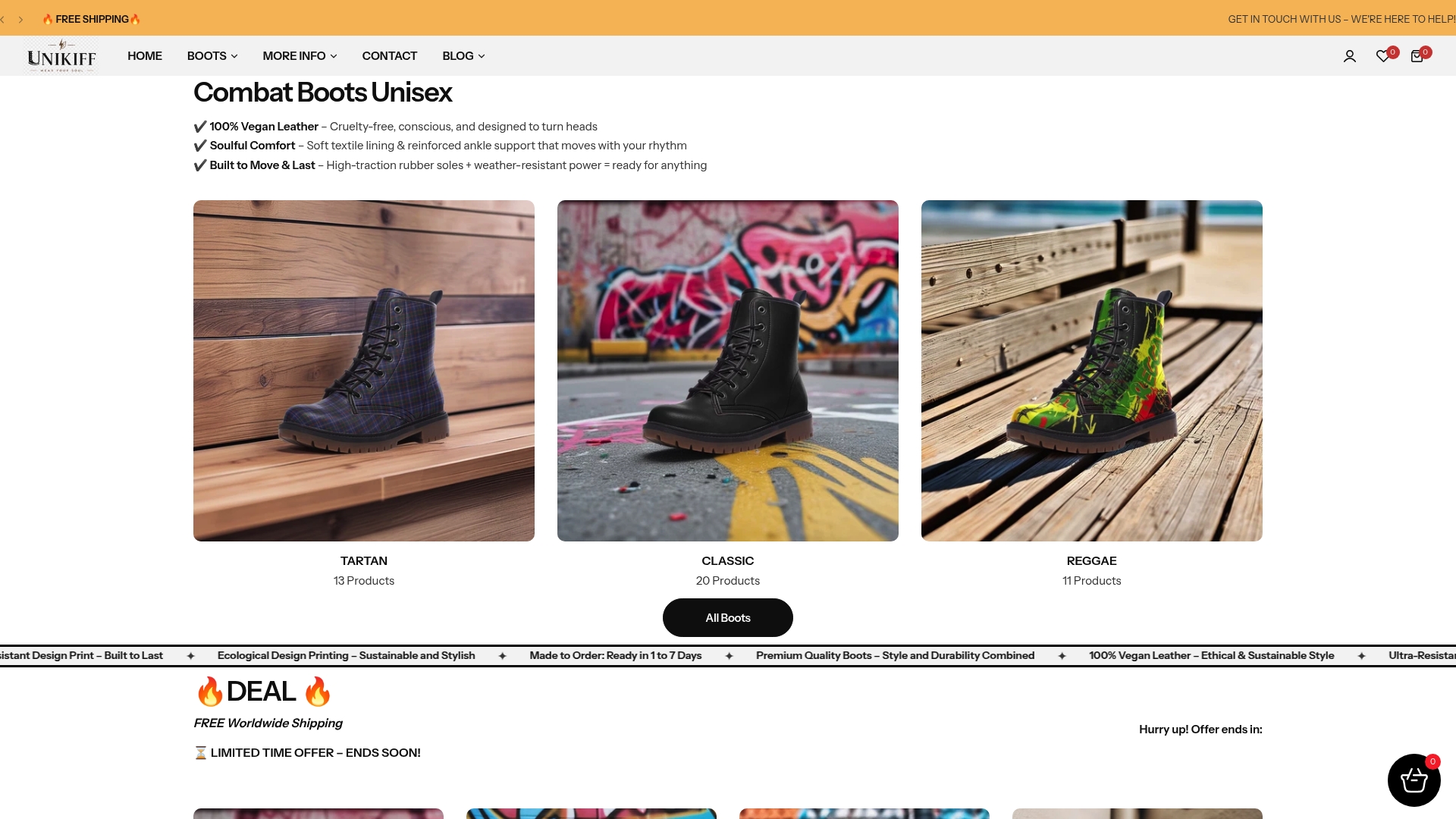
Before you order, check the size guide to lock in the right fit and skip a costly return. Browse the full lineup at Unikiff and find your pair today.
Sources
- Comparison of the Technical Performance of Leather, Artificial Leather, and Trendy Alternatives
- Vegan Uggs Are A Step Forward for Animal Rights, But Are They Truly Sustainable?
- Dr martens vegan boots
FAQ
What brands sell high-quality vegan boots?
Quality varies by brand and price band, with mid-range and premium sellers generally offering sturdier construction than budget marketplace listings. Unikiff focuses specifically on vegan combat boots with reinforced details and high-grip soles for everyday durability.
How much do boots cost?
Vegan boots typically range from under $100 for budget pairs to over $200 for premium or designer collaborations, according to retail price tracking. Mid-range pairs, priced between $100 and $200, usually offer the best balance of construction and return policy.
What are vegan leather boots?
Vegan leather boots use non-animal materials such as synthetic PVC or PUR, or bio-based alternatives like Piñatex and Desserto, instead of animal hide. A materials comparison study found these alternatives vary widely in durability and breathability depending on the specific material used.
Is there a vegan version of Uggs?
Designer collaborations have produced vegan boot styles inspired by shearling-style boots, including a limited run reported at £180 to £230 in coverage of the Uggs x Collina Strada collection. Pricing on collaborations like this tends to sit in the premium band rather than mainstream vegan footwear pricing.