


High-quality microfiber synthetic leather and well-made PU-coated uppers can absolutely handle everyday boot use, while many trendy plant-based materials still fall short on key durability metrics. The clearest signal comes from flex-cycle and abrasion testing rather than marketing claims about a material’s source. Construction matters just as much as the upper: seams, adhesives, and soles decide whether a tough material becomes a boot that lasts. Keep reading for the lab evidence, then jump to the buying checklist or care section depending on what you need right now.
TL;DR:
- Many vegan materials like microfiber synthetic leather and PU-coated textiles perform well in lab flex and abrasion tests, exceeding 80,000 cycles and resisting wear.
- Construction elements such as reinforced seams, stitched soles, and strong adhesives are crucial in translating material durability into a long-lasting boot.
- Plant-based alternatives generally fall short of required flex resistance and tear strength, making them less suitable for active or heavy use unless properly finished and tested.
- Proper care, including weekly cleaning and avoiding oil-based conditioners, can extend the lifespan of vegan boots, especially when paired with high-quality construction.
- Brands that disclose detailed test data and certification, like Unikiff, are more likely to provide durable vegan footwear that withstands real-world conditions.
Table of Contents
- Vegan boot materials: what your uppers are actually made of
- What lab tests and ISO standards say about vegan leather durability
- Why construction decides if a durable material becomes a durable boot
- How to clean and care for vegan boots so they last
- Buying checklist: how to spot a durable vegan boot before you order
- How Unikiff builds vegan combat boots for everyday durability
- The overlooked truth about vegan boot durability
- If you want a durable vegan combat boot now: where Unikiff fits
- Sources
- FAQ
Vegan boot materials: what your uppers are actually made of
Not all “vegan leather” is the same product wearing a different label. The material class determines how your boots will hold up to bending, scuffing, and weather long before construction ever enters the picture.
PU-coated textiles apply a polyurethane layer over a woven or knit base fabric. The coating gives a leather-like surface while the base fabric carries most of the structural load, so the weight and weave of that backing fabric matters more than people assume.
PVC uppers use a polyvinyl chloride coating, generally stiffer and less breathable than PU, with a tendency to crack in cold temperatures as the plasticizers that keep it flexible break down over time.
Microfiber synthetic leather builds up ultra-fine polyester fibers into a dense, leather-like structure, then finishes it with a polymer coating. This construction is part of the reason it performs well in lab testing, a point covered in the next section.
Plant-based composites like Piñatex (pineapple leaf fiber), Desserto (cactus), and mushroom or kombucha-derived materials use agricultural or fermented inputs bonded with resins or backing layers. Performance swings widely by brand and finishing process.
When you’re reading a product page, a few details separate a durable material from a marketing story:
- A named backing fabric or fiber weight, not just “vegan leather”
- Explicit test data or standards referenced (ISO categories, flex-cycle counts, abrasion cycles)
- Oeko-Tex or similar supplier certifications tied to the material batch
- A stated coating type (PU versus PVC) rather than a vague “synthetic” label
Unikiff’s own breakdown of sustainable materials for vegan leather footwear walks through how these material choices show up in actual boots, not just swatches.
What lab tests and ISO standards say about vegan leather durability
Marketing copy calls a lot of things “durable.” Lab testing is where that claim gets checked, and the results are more mixed than the branding suggests.
A peer-reviewed comparison of leather, artificial leather, and trendy alternatives tested Desserto, Kombucha-based material, Piñatex, Noani, Appleskin, Vegea, SnapPap, Teak Leaf, and Muskin against leather and PU-coated textile. Leather, Piñatex, and PU-coated textile all exceeded 80,000 flex cycles, while Teak Leaf, SnapPap, and Muskin fell short of what the researchers considered sufficient for footwear uppers.
Leather, Piñatex, and PU-coated textile all performed strongly in controlled testing, while several plant-based alternatives did not reach a suitable level of flex resistance, according to the MDPI comparative study. That gap matters because flex resistance predicts how an upper handles the constant bending your foot does with every step.
Separately, research into microfiber synthetic leather for footwear found it shows superior tensile and abrasion resistance compared with natural leather and PU in lab conditions, with strong flex resistance across multiple test cycles.
So what do you actually ask about? ISO 20344 test methods for footwear lay out the specific checklist:
- Upper flexing resistance (how the material holds up to repeated bending)
- Abrasion resistance (surface wear from friction and contact)
- Tear strength (resistance to ripping once a cut or weak point starts)
- Water penetration and absorption (how the upper handles moisture exposure)
- Whole-footwear tests, not just raw material swatches
Here’s the caveat that gets lost in most durability claims: a material passing 80,000 flex cycles in a lab is not the same as a finished boot surviving years of urban wear. Finishing, seam placement, and how the upper is actually assembled into a boot all affect the real-world result. A great material badly stitched will still fail early, which is exactly why the next section matters as much as this one.
Why construction decides if a durable material becomes a durable boot
A material that aces every lab test can still end up in a boot that falls apart in six months, because durability is a systems outcome, not a single-material score.
Seams are usually the first failure point. Look for reinforced stitching at stress zones (ankle flex points, toe box, heel counter) and a visibly dense stitch pattern rather than widely spaced thread. Thread type matters too: nylon or polyester thread resists abrasion and rot far better than cotton blends.

The outsole bond is the second major risk area. A glued sole can perform fine for a while, but a stitched or Goodyear-style welt construction generally holds up longer under repeated flexing and wet conditions. Check product photos for visible stitching around the sole edge, not just a smooth glued seam.
Watch for these common failure signs when you’re evaluating photos or reviews:
- Edge cracking where the coating meets a fold or seam
- Visible gaps or fraying at seam lines
- Any mention of sole separation or “delamination” in reviews
- A lining that looks thin or unattached to the upper’s structure
Manufacturers can reinforce weaker vegan materials with edge binding, laminated backings, and stronger adhesives, so a mid-tier material paired with smart construction sometimes outperforms a premium material assembled carelessly.
Pro Tip: Zoom into product photos around the toe box and heel seam. That’s where cheap construction shows up first, long before a review ever mentions it.
How to clean and care for vegan boots so they last
Good material and good construction still need good care. Most vegan upper failures trace back to the wrong cleaning product, not a manufacturing flaw.
- Wipe down uppers weekly with a soft cloth and mild soap and water. Skip oil-based leather conditioners: they are formulated for animal leather and can break down PU and PVC coatings over time.
- Test any waterproofing spray on a hidden panel first. Some silicone or solvent-based sprays react poorly with synthetic coatings, causing discoloration or stiffness.
- Re-coat PU finishes when they start looking dull using a product rated for synthetic uppers, following the manufacturer’s specific guidance rather than a generic leather product.
- Dry boots away from direct heat. Radiators and direct sun accelerate the same coating breakdown (sometimes called hydrolysis) that shortens the life of polymer-based uppers.
- Take seam separation or sole lifting to a cobbler early. Most shoe repair shops can re-glue or re-stitch a synthetic upper if you catch it before the gap widens.
Unikiff’s own guide to cleaning and maintaining vegan leather boots covers material-specific steps in more detail, and the suede care approach used for curated wardrobes shows the same principle applies across delicate uppers: consistent light care beats occasional deep cleaning.
Pro Tip: Keep a small tube of matching-color synthetic leather filler on hand. A five-minute touch-up on a fresh scuff stops it from turning into a crack.
Buying checklist: how to spot a durable vegan boot before you order
Before you add a pair to your cart, run through what the product page actually tells you, not just what the description promises.
Prioritize:
- Microfiber synthetic leather or PU-coated uppers with a named, substantial backing fabric
- Stitched sole attachment or welt construction over glue-only bonding
- Reinforced stitching at the ankle, toe, and heel stress points
- Any referenced test standard, flex-cycle count, or supplier certification
- A clear return or warranty policy, which signals the brand stands behind its construction
Treat cautiously:
- Plant-based materials marketed by ingredient name alone with no finishing or test detail
- Product pages with no mention of backing fabric, coating type, or stitch construction
- Reviews mentioning cracking, peeling, or sole separation within the first few months
| Use case | Recommended material | Construction to look for |
|---|---|---|
| Daily commuting | Microfiber synthetic leather or PU-coated | Stitched sole, reinforced seams |
| Festival or weekend wear | PU-coated textile | Reinforced toe and ankle stitching |
| Heavy outdoor or wet conditions | PU-coated with tested water penetration data | Welt construction, sealed seams |
For a broader look at trade-offs across material types, Unikiff’s pros and cons breakdown of vegan leather combat boots is worth a read before you commit, and a general primer on outdoor gear materials and durability is useful if you’re comparing boots against other footwear categories entirely.
How Unikiff builds vegan combat boots for everyday durability
The brand designs vegan combat boots focusing on construction factors beyond just the upper material. Boots with reinforced details at stress points, supportive ankle structure, and high-grip rubber soles can be suitable for city wear, festivals, and daily use where boots take real abuse.
Unikiff also publishes product-specific care guidance rather than leaving customers to guess at maintenance. That guidance pairs directly with the cleaning and protection steps covered earlier: the material class sets the ceiling on durability, but the day-to-day care habit is what determines whether you actually reach it. A well-built boot cared for properly and a well-built boot ignored for a year are not the same product by the time you’re done with them.
The overlooked truth about vegan boot durability
The most common mistake in durability conversations is treating “vegan leather” as one material with one durability score. It isn’t. The MDPI flex-cycle data makes that obvious: some plant-based materials competed with leather, others fell well short, and the difference had nothing to do with whether the source was animal or plant. It came down to how the material was engineered and finished.
Conventional advice tends to fixate on the upper alone, as if a tough fabric guarantees a tough boot. It doesn’t. Seams, adhesives, and outsole bonds fail more often than the upper material itself, and that’s a construction story, not a material story. If you take one thing from this guide, let it be this: ask about the whole boot, not just the fabric name.
Prioritize evidence over origin story. A cactus-derived material with no published test data tells you less than a PU-coated textile with a stated flex-cycle result. Durability lives in the details a brand is willing to disclose, and the brands worth trusting are the ones that show their work.
— David
If you want a durable vegan combat boot now: where Unikiff fits
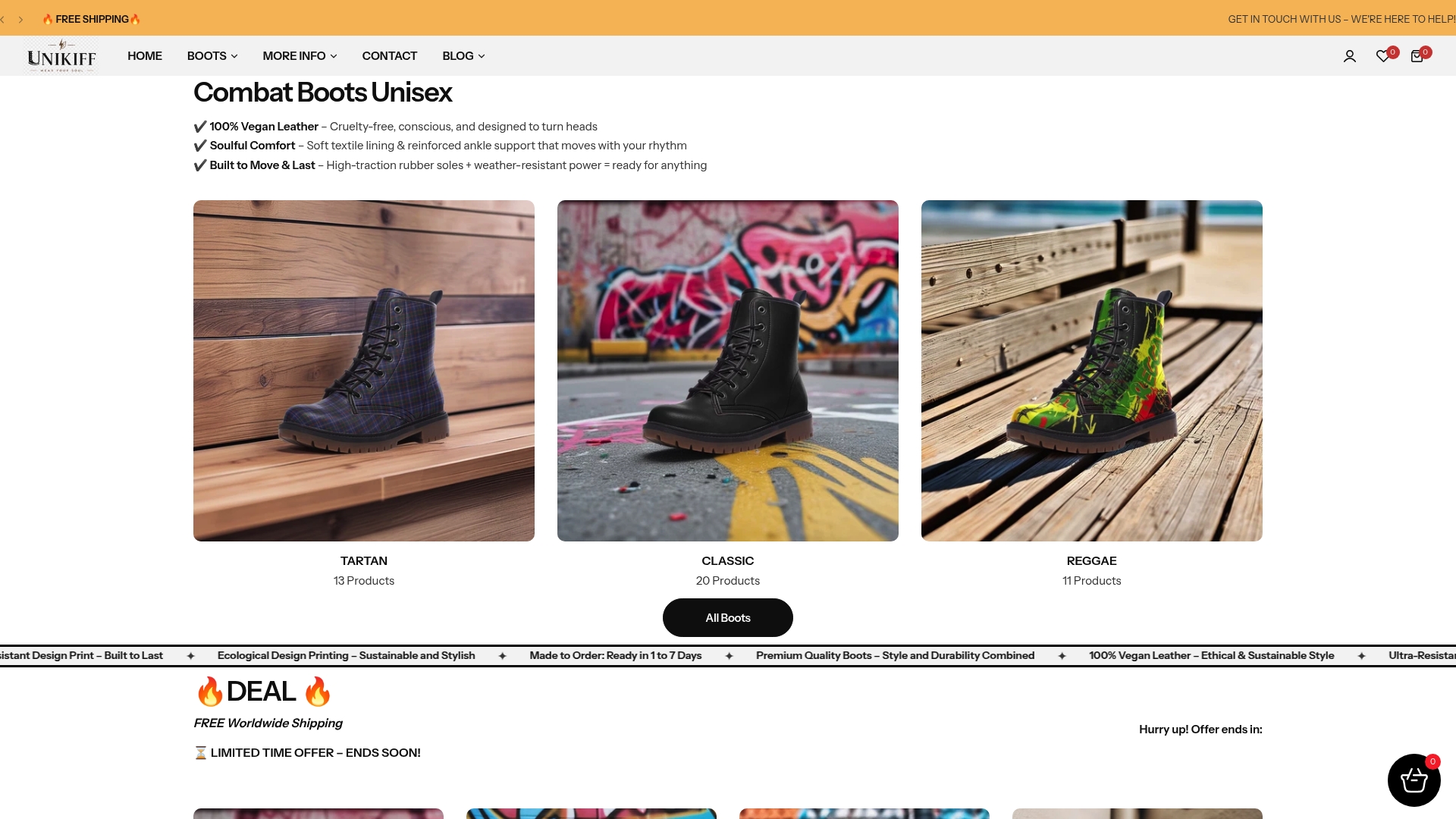
If you’ve read this far, you already know what to look for: reinforced stitching, a stable sole bond, and a material that holds up to real bending and abrasion. Unikiff’s vegan combat boots are built around exactly those construction choices, paired with high-grip rubber soles and supportive ankle structure, whether you’re after a classic everyday silhouette or a bolder statement piece.
A few collections worth browsing depending on your style:
- Classic Combat Boots for a durable, everyday solid-color pair
- Punk Combat Boots for reinforced, statement-ready designs
- Cottagecore Combat Boots for a softer aesthetic without sacrificing construction
Check the product care page and return terms before you order, so you know exactly what’s covered if anything needs attention down the line.
Sources
- Comparison of the Technical Performance of Leather, Artificial Leather, and Trendy Alternatives
- Comparative Analysis of the Properties of Synthetic and Natural Leathers: a Focus on Microfiber Synthetic Leather for Footwear Applications
- ISO 20344:2011 — Test methods for footwear
FAQ
Is vegan leather as durable as animal leather?
It depends on the specific material: peer-reviewed testing found that Piñatex and PU-coated textile matched leather’s flex-cycle performance, while several plant-based alternatives fell short. Leather’s layered natural structure gives it consistent all-round performance, but specific vegan materials can match it in targeted tests.
What are the downsides of vegan leather?
Some vegan materials, particularly PVC and untested plant-based composites, can crack, peel, or degrade faster than leather or well-made microfiber synthetics. The main risk is inconsistency: quality varies widely between brands and finishing processes, so the same material name can mean very different durability outcomes.
What happens when vegan leather gets wet?
Most PU and PVC-coated uppers resist light moisture well since the coating acts as a barrier, but prolonged soaking can degrade the coating over time through a process sometimes called hydrolysis. Untested plant-based composites may absorb water and lose structural integrity faster, which is why checking for stated water penetration results matters.
How do I maintain vegan leather boots?
Wipe uppers down regularly with mild soap and a soft cloth, and avoid oil-based conditioners made for animal leather since they can damage synthetic coatings. Test any waterproofing product on a hidden panel first, and address seam or sole issues early with a cobbler rather than letting small gaps widen, as detailed in Unikiff’s care guide.
How durable are vegan combat boots for daily wear?
Vegan combat boots built with microfiber synthetic leather or PU-coated uppers, stitched sole attachment, and reinforced seams can hold up well to daily wear. The material alone doesn’t guarantee it: construction quality, particularly at seams and the outsole bond, plays an equally large role in how long the boots actually last.