


Treat unisex boot sizes as men’s sizing and start there, then confirm with a real measurement. Women typically subtract about a size and a half from the men’s number as a rough starting point, but that offset changes by brand and last. Measure both feet standing, size to your larger foot, and leave 3/8 to 1/2 inch of room between your longest toe and the toe box before you commit to a size.
TL;DR:
- Unisex boots are generally built on men’s lasts, so measure your longer foot and round up to avoid tightness, especially with thick socks or insoles.
- Converting from men’s to women’s sizes involves estimating a 1.5 size offset, but this varies by brand and boot style, so always confirm with your measurement.
- Proper fitting depends on more than length; consider width, instep height, and last shape, since two boots of the same size can fit differently due to internal mold.
- Use a Brannock device or a traced foot and measure standing at the end of the day for the most accurate result, and always size to your larger foot.
- Check product-specific notes for style-related fit changes, such as pointed toes or platform soles, which can alter how the size feels despite correct length.
Table of Contents
- Unisex Boot Sizing Chart: US, EU, and Centimeters
- How to Measure Your Feet for Unisex Boots
- Why the Same Size Can Fit Differently Across Boots
- Real Conversion Examples You Can Copy
- Unikiff’s Approach to Unisex Vegan Combat Boot Sizing
- Measure First, Then Let Style Guide the Half Size
- Find Your Size and Shop Unikiff’s Vegan Combat Boots
- Where This Guide Gets Its Sizing Advice
- Sources
- FAQ
Unisex Boot Sizing Chart: US, EU, and Centimeters
Unisex sizing almost always follows the men’s scale, so the fastest way to get in the ballpark is to line up your foot length against a men’s, women’s, and metric column at once. Here’s a quick reference for common sizes:
A few rules make this chart actually useful instead of just decorative:
- Pick the row that matches your longest foot’s measured length in centimeters or inches, not the size you “usually wear” in a different brand.
- Round up, not down, if you plan to wear thick socks, insoles, or orthotics inside the boot.
- Treat the US women’s ≈ US men’s + 1.5 conversion as a starting estimate only. Some manufacturer and issued-boot guidance shows women’s adjustments ranging anywhere from 1 to 3.5 sizes smaller depending on the specific boot model, so don’t assume a single fixed offset applies everywhere.
- EU sizes often span a half US size, which is why two US sizes can map to the same EU number.
How to Measure Your Feet for Unisex Boots
Skip the tape-measure guesswork. Do this instead:
- Measure at the end of the day. Feet swell a little with hours on them, and orthopaedic fitting guidance recommends trying on shoes when your feet are at their largest, not right after you wake up.
- Wear the socks you’ll actually wear with the boots. A thick wool sock changes your effective foot volume more than most people expect.
- Stand on a sheet of paper and trace your heel and longest toe. Standing shifts your foot’s flex point compared to sitting.
- Measure heel to toe, then heel to the ball of your foot. The Brannock device method compares both numbers, because a mismatch between your arch length and overall length can mean the boot’s flex point never lines up with your foot’s.
- Measure both feet separately, and size to the larger one. Most people have a foot that’s slightly bigger, and footwear fit experts are consistent on this point: never size down to fit the smaller foot.
- Round up when you’re between sizes, especially with boots, where half sizes are often better handled by rounding up rather than down.
A Brannock device gives you the most accurate reading because it measures length and width at once, but a ruler and a traced foot outline will get you close enough for most online purchases.
Pro Tip: Feet change over time. If you haven’t measured yours in the last few years, do it again. Weight changes, pregnancy, and normal aging can add a half size or more to your feet that you might not have noticed.
Why the Same Size Can Fit Differently Across Boots
Length is only half the story. The last, the mold a boot is built around, determines the internal shape: how tall the toe box sits, how much the boot tapers toward the toe, and how snug the heel pocket feels. Two boots labeled the same size can fit completely differently because their lasts aren’t the same. Research on foot shape and footwear fit backs this up: men’s lasts often carry more internal volume than women’s lasts, which is part of why a straight length conversion doesn’t guarantee a comfortable fit.
A few things worth checking before you decide a size is right:
- Width letters (B, D, EE) aren’t standardized across manufacturers, so a “medium” in one brand can run narrow in another.
- Heel slip with correct length usually means a lacing, insole, or last problem, not a sizing problem. Sizing up to fix heel slip often just creates too much toe room and changes how you walk, according to analysis of real-world boot fit.
- If your foot is notably wide or narrow, a different width option (where available) usually solves more than a different length would.
- Instep height matters for lace-up boots specifically. A high instep with a snug last can feel tight even when the length is correct.
Real Conversion Examples You Can Copy
Numbers make this easier to picture:
- A women’s US 8 starts around a unisex (men’s) 6.5 to 7. Measure first, since actual fit varies by last.
- A men’s US 7 maps roughly to a women’s 8.5 to 9, again as a starting estimate rather than a guarantee.
- Wearing thick socks or orthotic inserts? Go up half a size, or look for a wider last if one is offered.
- Landed on a half size in the unisex chart? Round up. A slightly loose boot is easier to fix with an insole than a tight one is to stretch.
Unikiff’s Approach to Unisex Vegan Combat Boot Sizing
Unikiff builds its vegan combat boots on a unisex last, so the same fit logic above applies directly when you shop the collection. A few things to keep in mind that are specific to Unikiff’s construction:
- The lace-up closure gives you real adjustability across the instep, which helps if your foot is narrower or wider than average for your length.
- The supportive ankle structure and reinforced detailing add a small amount of internal volume compared to a slip-on boot, so most shoppers find their measured size fits true to length.
- A medium-weight sock is the safest baseline for trying on, since it splits the difference between bare-foot and heavy winter sock volume.
- Before ordering, check the Unikiff size guide against your own measurement, and browse the Classic Combat Boots collection to see how the standard last fits different foot shapes.
Measure First, Then Let Style Guide the Half Size
Measuring correctly solves most sizing problems before they start, but the last real variable is style. A pointed toe or a thicker platform sole can shift how a boot feels even at the correct length, so it’s worth checking product-specific notes rather than assuming every silhouette fits identically. If you’re also figuring out how a pair works with your wardrobe, a piece like styling combat boots for different occasions is worth a read once your size is locked in.
— David
Find Your Size and Shop Unikiff’s Vegan Combat Boots
Some vegan combat boots are built on a unisex last, so instead of guessing at a men’s-to-women’s conversion, you check one size chart built specifically for the boots you choose. That’s the real advantage here: no translating a generic unisex offset across brands with different lasts, just one guide made for the boots you’re actually buying.
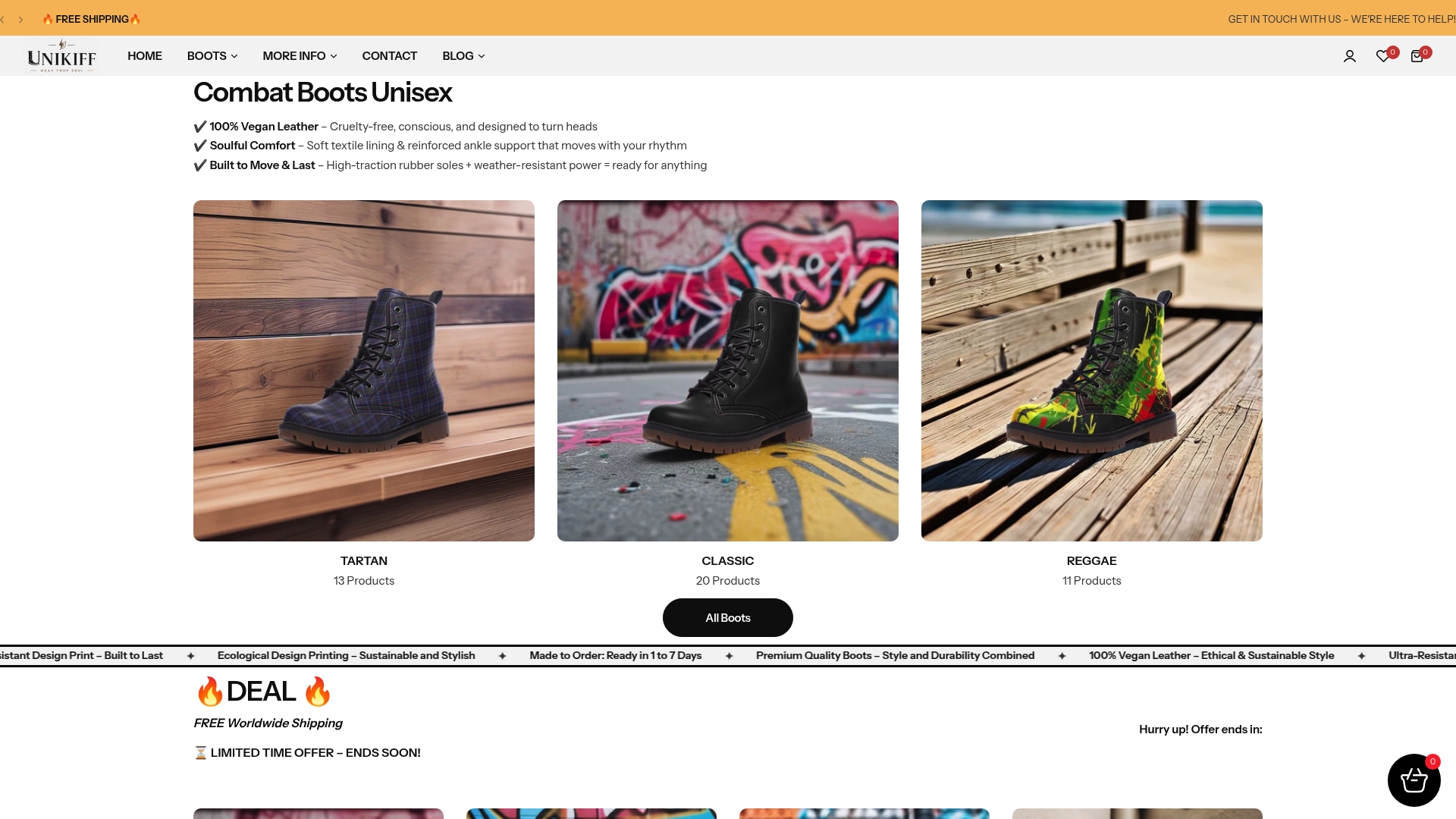
Start with the Unikiff size guide to match your measured foot length to the exact size for the style you want. The lace-up closures, ankle support, and reinforced details are consistent across the line, whether you’re drawn to the Punk Combat Boots, the Skull Combat Boots, or the softer palette of the Cottagecore Combat Boots. Measure your feet, check the chart, and pick the pair that matches your style.
Where This Guide Gets Its Sizing Advice

The measuring and clearance recommendations here come from FootCareMD’s proper shoe fit guidance, the Brannock Device Company’s official fitting instructions, and peer-reviewed research on how footwear lasts affect fit. Each source backs a specific claim: standing measurement and toe clearance, heel-to-ball technique, and last-driven fit differences.
Sources
- How to help: 10 points of proper shoe fit | FootCareMD
- Instructions & Fitting Tips | The Brannock Device Company
- Study on foot shape and footwear last effects on fit (PubMed)
FAQ
If a Boot Is Unisex, What Size Should I Get?
Start with your measured foot length in the men’s size column, since unisex boots are almost always built on a men’s or unisex last. Confirm the fit by leaving 3/8 to 1/2 inch of toe room and sizing to your larger foot.
What Size Do I Get in Unisex?
Measure both feet standing, in the socks you plan to wear, and use your longer foot’s length to find the matching size on a unisex chart. If you’re between sizes, round up rather than down.
What Is a Men’s Size 7 Boot in Women’s Sizing?
A men’s 7 typically converts to roughly a women’s 8.5 to 9, though the exact offset depends on the brand and last. Treat it as a starting point and verify with a direct foot measurement before buying.
What Is a Women’s Size 8 in Unisex Sizing?
A women’s 8 generally lands around a unisex (men’s) 6.5 to 7. Confirm this against your actual measured foot length, since conversion offsets can range more widely depending on the specific boot style.
How Much Toe Room Should Unisex Boots Have?
Leave about a thumb’s width, or 3/8 to 1/2 inch, between your longest toe and the front of the boot. This is a standard orthopaedic fitting recommendation that applies regardless of whether the boot is labeled unisex, men’s, or women’s.