


The fastest reliable way to make combat boots comfortable is to confirm correct fit, lock your heel with a runner’s loop, wear moisture-wicking socks, and follow a short-wear progressive break-in plan. Add temporary cushioning like insoles or heel pads while the boots soften up, and stick to the staged wear schedule instead of forcing them. If the boots pinch your toes at the widest part of your foot or the toe box feels crushed (common in steel-toe styles), that’s a fit problem no amount of breaking in will fix.
TL;DR:
- Using a heel-lock lacing pattern reduces heel slip and prevents blisters by minimizing internal foot movement inside the boot.
- A proper fit requires trying boots with your actual socks, checking toe space, and ensuring minimal heel lift before starting the break-in process.
- Moisture-wicking socks combined with targeted conditioning of stiff zones can significantly decrease blister risk and improve comfort during prolonged wear.
- Rushing the break-in process with water or heat damages the materials and does not shorten the time needed to soften and mold the boots.
- Starting with an accurately sized vegan boot simplifies the break-in, as vegan materials stretch less and require careful initial fitting to avoid discomfort later.
Table of Contents
- Your step-by-step boot break-in plan
- Getting the fit and lacing right from the start
- Choosing the right insoles and cushioning for your pain point
- Socks and moisture control that actually prevent blisters
- Caring for vegan and leather uppers without damaging them
- Quick fixes for hot spots and pain during the day
- What years of boot questions have taught me
- Where Unikiff fits if you want less break-in from the start
- Sources
- FAQ
Your step-by-step boot break-in plan
Rushing a new pair of boots is how blisters happen. A slow, structured approach gets you to all-day comfort without the damage.
Before you wear them anywhere:
- Put on the socks you’ll actually wear daily, not thin dress socks, and lace up fully.
- Stand and wiggle your toes. You want a thumb’s width of space at the front.
- Walk a few steps and check heel lift. Some movement is normal in new boots, but your heel shouldn’t slide more than a quarter inch.
- Flex the boot by hand at the ball of the foot to loosen the sole hinge before you ever step outside.
The wear schedule that works:
- Days 1 to 3: wear the boots around the house for short periods, laced snug.
- Days 4 to 5: take them on short errands or walks, gradually extending time.
- Days 6 to 7: wear them for a half day, monitoring feet for hot spots.
- Week two onward: proceed to full-day wear once feet show no signs of irritation or pain.
Apply a leather or vegan-safe conditioner only to stiff zones, usually the ankle collar and the crease at the ball of the foot, then work it in by hand-flexing the boot repeatedly until the material gives a little. Tactical boot guides recommend this targeted approach over conditioning the whole boot, since over-softening weakens structure you actually need for support.
Avoid soaking boots in water, blasting them with a hair dryer, or wearing them a size loose to “speed things up.” None of these actually shorten break-in. Heat and water damage adhesives and stitching, and a loose fit just adds the friction and slippage that cause blisters in the first place. A progressive wear schedule paired with conditioning only where the boot actually needs to flex is the approach most tactical and boot-specific guides land on.
Pro Tip: Break in new boots in the evening after your feet have swollen slightly from a full day on them: if they feel good then, they’ll feel good anytime.
Getting the fit and lacing right from the start
Most boot discomfort traces back to fit, not the material. Fixing lacing and length solves more problems than any insole ever will.
- Try boots on with the socks you plan to wear daily, since sock thickness changes fit more than people expect.
- Check width at the ball of your foot first: your foot should sit flat with no pinching at the sides.
- Test heel lift by walking a full lap of a room before deciding a boot needs breaking in versus needs to be a different size.
- If the boot fits everywhere except the heel, a heel-lock lace pattern usually solves it without buying a new pair.
To tie a heel-lock (runner’s loop), lace normally to the second-to-last eyelet, then feed the lace back through the same-side eyelet to form a small loop instead of crossing it over. Cross the laces through both loops and pull tight before tying off. This pulls the heel back into the boot’s heel cup and stops the sliding that causes deep blisters. A heel-lock lacing pattern is one of the most common fixes recommended for heel slip in tactical and combat boots.
Podiatry research on friction blisters points to why this works: blisters form from repetitive shear, meaning the bone and soft tissue move against the boot’s interior over and over. Reducing that internal motion matters more than any surface lubricant. A surgeon’s knot, tied by double-wrapping the lace at the ankle eyelet before continuing up, adds a secondary lock point for boots with a wide ankle opening. If you still have extra volume around the heel, a thin heel grip or a stacked insole can take up the space without changing your overall fit.
Pro Tip: Lace your boots from the bottom up in stages, tightening the ankle and heel section separately from the shin, so each zone gets exactly the pressure it needs instead of one uniform pull.
Choosing the right insoles and cushioning for your pain point
Not every insole solves every problem. Matching the insole type to where you actually hurt saves you from buying three pairs before finding one that works.
- Gel insoles cushion the heel strike and work well if your pain shows up after standing on hard floors for hours.
- Foam or EVA insoles distribute pressure across the whole foot and suit people whose discomfort is spread out rather than localized.
- Shock-absorbing insoles reduce impact directly under the heel and are backed by walking studies showing lower peak pressure and better perceived comfort compared with no insole.
- Arch-support insoles help if you have a noticeable arch and feel strain along the bottom of your foot, but they can worsen fit in a low-volume boot by pushing your foot upward into the laces.
When you add an insole, always check what it does to heel space. If your heel starts lifting more than before, pair the insole with a thin heel pad or swap to a slimmer boot-specific insole rather than stacking two thick ones. Trim any insole to match your boot’s insole shape exactly, since a wide edge can curl up and create a new pressure point along the side of your foot. In steel-toe boots, remember the toe box has almost no room to expand, so keep insole thickness minimal up front and reserve cushioning for the heel and midfoot. If pain persists after trying a few insole types, that’s usually a signal to talk to a podiatrist about custom orthotics rather than cycling through more store-bought options.
Socks and moisture control that actually prevent blisters
Sock choice changes your blister risk more than most people realize. Cotton holds sweat against your skin, and that moisture is part of the problem, not just the discomfort.
- Choose moisture-wicking technical socks over cotton, since research on foot hydration and sock type links higher skin moisture to more dermal lesions, while sweat-wicking socks reduce them.
- Layer a thin liner sock under a thicker cushioned outer sock if you’re on your feet for long shifts, and change socks midday if your feet feel damp.
- Use foot powder or an antiperspirant on feet prone to heavy sweating, especially in warmer months or during long outdoor wear.
- Apply a lubricant like petroleum jelly or a blister patch preemptively on spots that have blistered before, rather than waiting for pain to start.
One of the most reliable levers for blister prevention is stabilizing motion at the source. Podiatry research describes blister formation as a combination of shear deformation, friction force, and repetition, meaning a stable fit plus dry skin removes two of the three ingredients before they ever combine.
Combining a snug, heel-locked fit with moisture-wicking socks tends to outperform any single fix on its own, since each measure interrupts a different part of the blister cycle.

Caring for vegan and leather uppers without damaging them
Vegan combat boot uppers behave differently than animal leather, and treating them the same way can backfire. Most vegan materials stretch less over time and are more sensitive to heat than full-grain leather.
- Use a conditioner or care product labeled safe for vegan or synthetic leather rather than a traditional leather oil.
- Apply conditioner sparingly to stiff zones only, working it in with your fingers and letting it absorb before wearing the boots again.
- Hand-flex the upper repeatedly at the ankle collar and ball of the foot to loosen fibers gradually instead of relying on the product alone.
- Never soak vegan uppers in water or dry them near direct heat, since both can crack or delaminate the material.
Vegan-shoe care guides consistently warn that because vegan materials stretch less than animal leather, getting the size right matters more from the start rather than counting on the boot to stretch to fit later. Our combat boot care guide covers upper-specific cleaning and conditioning steps in more depth. If a boot still feels rigid in one specific spot after a few weeks of wear, a shoe repair shop with a boot stretcher can target that single zone rather than risking damage from more conditioner.
Pro Tip: Condition vegan uppers right after a light wipe-down, while the material is slightly warm from wear, since it absorbs care product more evenly than when it’s cold and stiff.
Quick fixes for hot spots and pain during the day
Sometimes you need a fix that works right now, not tomorrow. Keep a small kit with you during the break-in period.
- Moleskin or blister patches applied directly to a hot spot before it blisters can save an entire day of wear.
- Athletic tape wrapped smoothly over problem areas reduces direct friction against the boot’s interior lining.
- Heel grips inserted at the back of the boot stop slippage instantly if your heel lifts during walking.
- Loosen the top two eyelets slightly if the tongue is biting into your shin, and tighten the ankle section instead to keep support without the pressure.
If pain shows up specifically across the top of your toes or along the sides of a steel-toe box, that’s usually a fixed structure that won’t give with wear, and no amount of tape or insoles will solve it long term. At that point, a cobbler can sometimes stretch a leather upper, but a vegan boot with a rigid toe cap may need a size or model change instead. Persistent pain in the same spot after two weeks of consistent, careful wear is your signal to stop pushing through it.
What years of boot questions have taught me

The biggest misconception I hear is that boots need to hurt before they get comfortable. They don’t. A boot that’s still causing pain after two honest weeks of a proper break-in schedule was likely the wrong size or width from day one, not a boot that “just needs more time.”
The combination that consistently works is boring but effective: correct fit, heel-lock lacing, and moisture-wicking socks, applied together rather than one at a time. Skipping any one of those three and hoping cushioning alone will fix things usually just delays the same problem.
— David
Where Unikiff fits if you want less break-in from the start
A boot that fits well the day it arrives needs a lot less babying than one you’re fighting for weeks. Some vegan combat boots are built with supportive ankle structures, reinforced stitching at stress points, and high-grip rubber soles, details that can hold up under daily wear once past the initial break-in period.
- Check our vegan combat boots size guide before ordering, since getting width and length right up front matters more with vegan uppers than with stretchier animal leather.
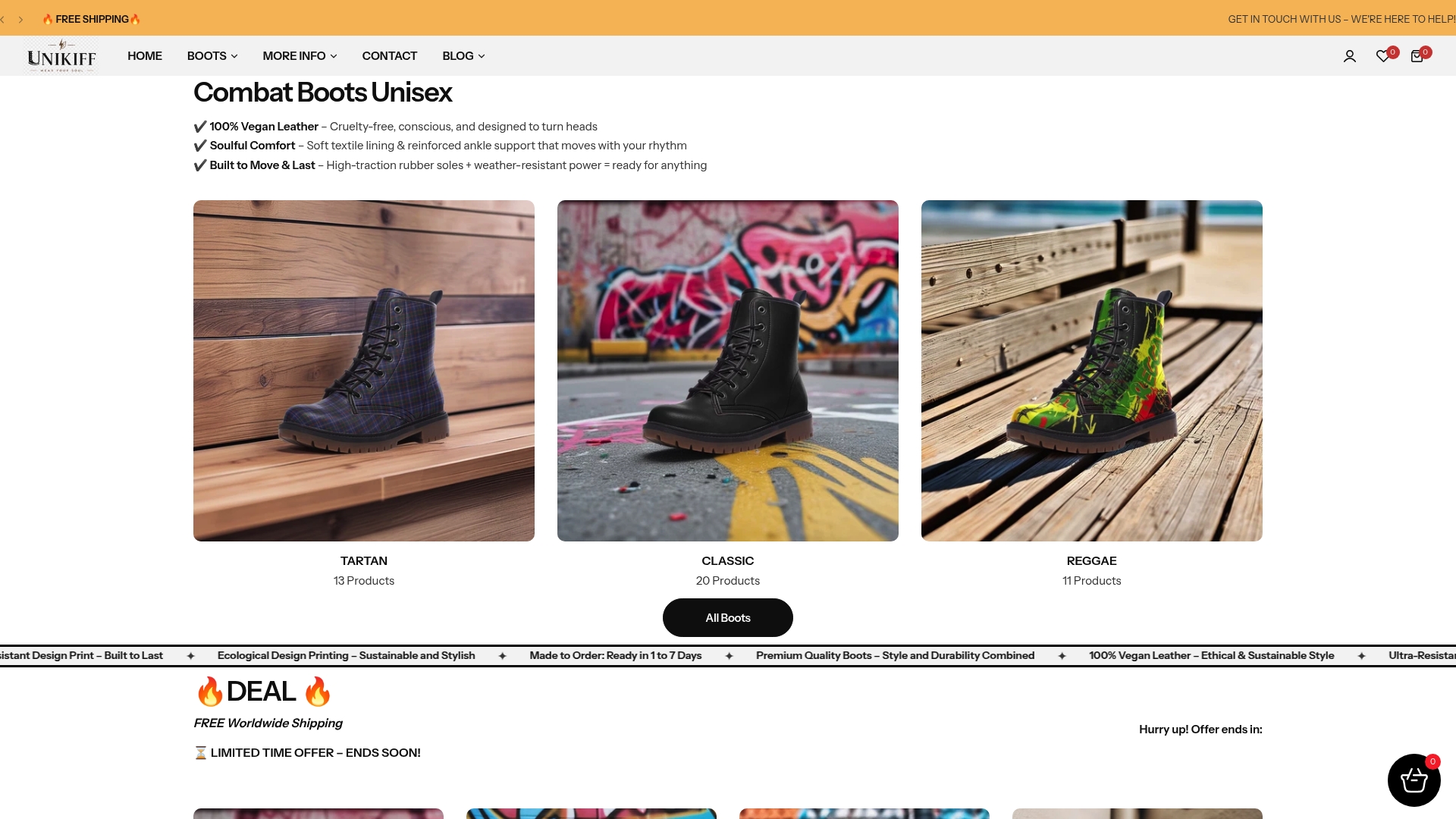
- Browse the full vegan combat boots collection for solid colors and printed styles across gothic, punk, grunge, and cottagecore looks.
- Pair your boots with moisture-wicking socks and the heel-lock lacing technique from this guide, and you’ll cut the break-in period down noticeably.
None of this replaces the break-in steps above. Even a well-fitted boot benefits from short wears and hand-flexing during the first week, but starting from an accurate size means you’re solving for comfort instead of fighting a fit that was wrong from the start.
Sources
This guide draws on podiatry research into friction blister causation, a study linking foot hydration and sock choice to dermal lesions, and walking research on shock-absorbing insoles. Practical break-in and lacing steps come from tactical boot lacing guidance and boot break-in resources built for daily and extended wear. For foot aftercare between wears, the foot scrub guide from Bradenton Nails offers useful skin-condition tips.
- Friction blisters of the feet: a new paradigm to explain causation - PMC
- Study on foot hydration, socks, and dermal lesions (PubMed)
- Shock-absorbing insoles study (MDPI Healthcare)
- Firsttactical
FAQ
How do I make combat boots more comfortable fast?
Confirm correct fit, use a heel-lock lace pattern, switch to moisture-wicking socks, and add a shock-absorbing insole while you break the boots in gradually. These four changes address fit, friction, moisture, and impact at the same time, which is why they work faster together than any single fix.
How can I break in combat boots quickly without hurting my feet?
Wear them in short sessions for a few days, gradually extending the wear time before aiming for half days. Avoid soaking them or using high heat to speed things up, since tactical break-in guides warn this damages materials rather than softening them safely.
Is there a real way to make boots more comfortable, or is discomfort normal?
Discomfort is common with new boots but it isn’t something you have to accept. A combination of correct sizing, heel-lock lacing, and moisture-wicking socks addresses the main causes of blisters and pressure identified in podiatry research on friction blisters.
Are combat boots generally comfortable to wear for long periods?
Combat boots can be comfortable for extended wear once properly broken in and laced to stabilize the heel and midfoot. Comfort depends heavily on getting the size right initially, since vegan and leather uppers both stretch less than people expect and won’t fully correct a poor fit on their own.