


Eco-friendly shoe materials fall into three main families: recycled synthetics, natural fibers, and bio-based leathers like mycelium and Piñatex. Each trades off differently between durability and end-of-life impact, and that trade-off, not any single “green” label, is what should drive your decision. Before you buy, know what each family does well, where it fails, and what hidden parts of the shoe can undo all of it.
TL;DR:
- Most shoes contain multiple materials, making recycling difficult due to the complex mix of components like adhesives, eyelets, and dyes that often remain undisclosed.
- Certified claims such as GRS or GOTS verify recycled content or organic fibers but do not guarantee full transparency of all shoe components or end-of-life options.
- Industrial composting is generally required for biodegradability claims, but very few shoes will break down properly outside specialized facilities, limiting real compostability.
- Repair, resale, and take-back programs typically have a greater environmental impact than single-material biodegradability claims for footwear.
- Durable, repairable, and fully transparent shoes, especially vegan boots built with high-quality materials, often outperform environmentally promising but short-lived or incomplete “green” options.
Table of Contents
- What Are Eco-Friendly Shoe Materials, Exactly?
- Recycled PET to Mycelium: How the Major Materials Compare
- The Sustainability Gaps Most Shoe Shoppers Miss
- How to Evaluate Green Claims Without Getting Fooled
- Can You Actually Recycle or Compost Your Old Shoes?
- Where Unikiff Fits Into This Conversation
- The Trade-Off Nobody Puts on the Label
- Get Cruelty-Free Boots Built to Actually Last
- Sources
- FAQ
What Are Eco-Friendly Shoe Materials, Exactly?
Sustainable footwear draws from five broad material groups, and each one shows up in a different part of the shoe. Knowing where they land helps you read a product page instead of just trusting the marketing copy on it.
Recycled synthetics (recycled PET, regenerated nylon, recycled rubber) usually make up uppers, laces, and sometimes outsoles. They divert plastic waste from landfills but are still petroleum-based at their core, so they don’t biodegrade on their own.
Natural fibers like organic cotton, hemp, and lyocell typically appear in linings, canvas uppers, and laces. They come from renewable plant sources and generally compost more readily than synthetics, though processing methods vary widely in water and chemical use.
Bio-based leathers, including mycelium (mushroom-based) and Piñatex (pineapple-leaf fiber), are engineered to replace animal or plastic leather in uppers. Most still rely on a polyurethane or bio-based resin coating for durability, which complicates end-of-life claims.
Natural rubber, tapped from rubber trees, shows up in outsoles for its grip and flexibility. It’s biodegradable in theory, but most commercial rubber soles are blended with synthetic rubber for wear resistance.
Plant-based foams (like foams made from algae or castor bean oil) are newer entrants in midsoles, aiming to replace petroleum-based EVA.
A shoe’s sustainability story rarely lives in one material. Uppers get the marketing spotlight, but soles, linings, and adhesives often make up half the shoe’s mass and carry a very different environmental profile than whatever fabric sits on top.
- Uppers: recycled synthetics, natural fibers, bio-based leathers
- Outsoles and midsoles: natural rubber, recycled rubber, plant-based foams
- Linings: organic cotton, lyocell, recycled polyester
- Adhesives and reinforcements: usually conventional synthetics, rarely disclosed
Recycled PET to Mycelium: How the Major Materials Compare
Not all eco-friendly materials deliver the same performance, and the differences matter once you’re the one walking in them every day.
Recycled PET comes from shredded and re-spun plastic bottles, most often turned into knit uppers or lace webbing. It performs close to virgin polyester on breathability and stretch, and it holds up well to daily wear. The catch: it still sheds microplastics during washing and manufacturing, and it’s not biodegradable regardless of the recycled content.
Recycled rubber reclaims scrap from tires and factory offcuts for outsoles. It’s tough, offers solid grip, and cuts down on waste that would otherwise sit in landfills for centuries. The trade-off is limited flexibility compared to virgin rubber compounds, which some brands offset by blending in a small amount of new rubber.
Hemp grows with far less water than cotton and needs minimal pesticides, making it a strong choice for canvas uppers and linings. It’s durable and breathable but coarser against skin unless blended with a softer fiber.
Organic cotton avoids synthetic pesticides and fertilizers, which reduces soil and water contamination during farming. It’s comfortable and compostable in home conditions, though it wears out faster than synthetic linings under heavy use.
Lyocell is a wood-pulp fiber processed in a closed-loop system that recycles most of its solvents. It’s soft, moisture-wicking, and biodegradable, but it’s mostly limited to linings rather than structural parts of the shoe.
Mycelium leather is grown from fungal networks fed on agricultural waste, then compressed into sheets that mimic leather’s texture. Early versions cracked easily, but newer formulations hold up closer to genuine leather on flexibility. Most mycelium leathers still need a thin polyurethane coating for water resistance, which limits full compostability.
Piñatex is made from pineapple leaf fibers left over from fruit harvests, a genuinely clever use of agricultural waste. It’s breathable and lightweight, but like mycelium leather, it typically carries a resin finish that keeps it from composting cleanly.
PHAs (polyhydroxyalkanoates) are bio-based plastics produced by microorganisms fed on plant sugars. They can biodegrade in marine and soil environments under the right conditions, and they’re starting to appear in experimental midsoles and 3D-printed components.
Soleic Foam, developed through algae-based polyurethane research, is one of the more promising proof points that biodegradable foam doesn’t have to mean flimsy foam. Researchers at UC San Diego built the first fully biodegradable shoe sole using this approach, pairing it with plant-fiber knit uppers, and reported that it broke down in compost within months rather than sitting in a landfill for decades. That project, along with the Korvaa concept shoe built from mycelium, bacterial nanocellulose, and PHA-based 3D-printed soles, shows bio-based materials can approach conventional performance. Both are still closer to lab and concept stage than mass retail, though.
Vegetable-tanned leather replaces chromium tanning with plant-based tannins like bark and tree leaves, cutting some of the heavy-metal runoff associated with conventional tanning. It still relies on animal hides, so it carries the emissions and land-use footprint tied to livestock farming, and it isn’t vegan.
Materials complexity check: A single pair of shoes can contain as many as 40 different materials, from the upper fabric down to the eyelets and thread. That complexity is exactly why a shoe billed as “made from recycled ocean plastic” can still be nearly impossible to recycle at the end of its life.
The Sustainability Gaps Most Shoe Shoppers Miss
A shoe’s greenest-looking feature is often the one that matters least. Adhesives, reinforcements, eyelets, thread, and dyes rarely appear on a product page, yet they can make up a meaningful share of a shoe’s total materials and its total footprint.
Most shoe adhesives are solvent-based synthetic compounds that don’t biodegrade and can complicate recycling even when the rest of the shoe is compostable. Metal eyelets and shanks, the stiff inserts that support the arch, are standard components that almost never get disclosed, and they’re the usual failure point when a shoe designed for circularity hits a recycling facility. Thread and dyes round out the list. Synthetic thread resists breakdown, and conventional dyes can introduce heavy metals into runoff during production.
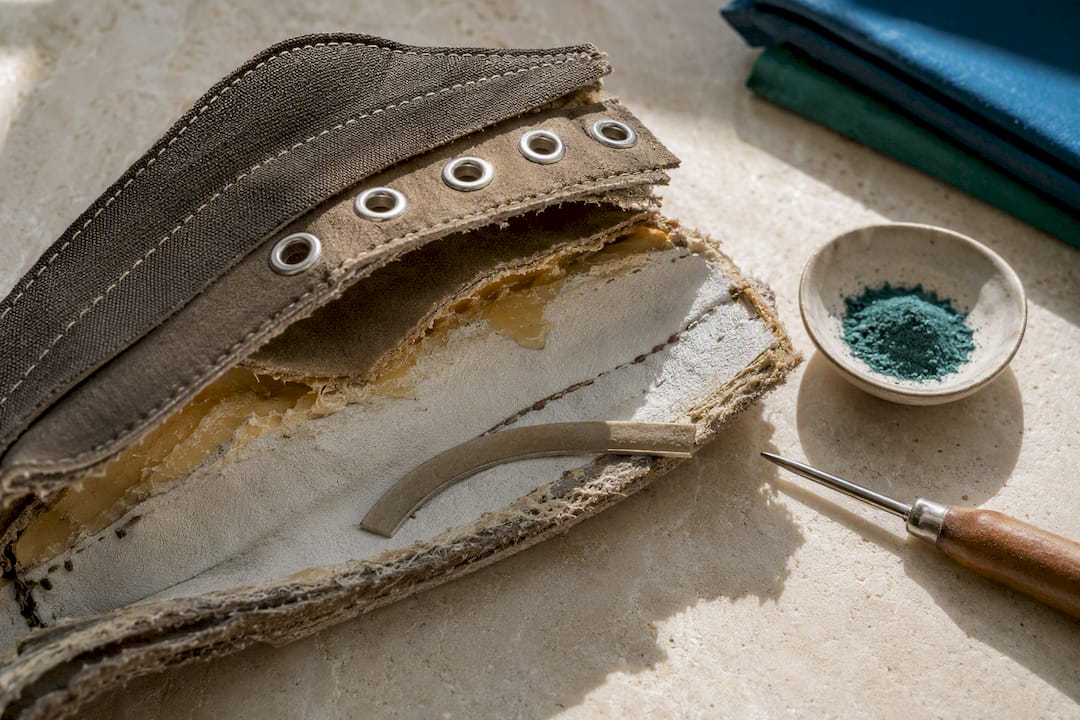
This is where greenwashing tends to hide. A brand highlights a pineapple-fiber or recycled-cotton upper in bold text, while the sole, adhesive, and lining stay conventional synthetic. Marketing built around one visible material is common enough that experts now argue real sustainability claims require full bill-of-materials transparency, not a single ingredient callout.
Here’s how to verify a claim before you trust it:
- Check whether the brand lists materials for every component, not just the upper.
- Look for a named certification tied to the specific claim (compostable, recycled content, or cruelty-free), not just a generic “eco” badge.
- Ask customer service directly what the sole, adhesive, and lining are made from.
- See if the brand documents an actual end-of-life pathway, such as a take-back or repair program.
- Compare the stated durability or warranty period against similar conventional shoes.
Pro Tip: If a product page only mentions one “sustainable” material and stays vague about everything else, treat that vagueness as the answer. Brands proud of their full material list usually say so.
How to Evaluate Green Claims Without Getting Fooled
Certifications are useful shortcuts, but only if you know what each one actually verifies. Here’s a quick reference for the ones you’ll see most often on footwear.
| Certification | What it actually verifies |
|---|---|
| GRS (Global Recycled Standard) | Tracks recycled content through the supply chain and checks basic social and environmental practices |
| GOTS (Global Organic Textile Standard) | Confirms organic fiber content and restricts harmful chemical processing in textiles |
| ASTM D5511 | Sets the industrial composting standard for biodegradability, not home composting |
| Leather Working Group | Rates tanneries on environmental practices, relevant mainly for animal-leather sourcing |
Beyond the certification badge, durability signals tell you more about lifetime impact than any single material claim. A stated expected lifespan, a resoling or repair option, reinforced stitching at stress points, and a clear returns or warranty policy all point to a brand that expects its shoes to last. When you’re comparing options, ask these questions directly:
- Does the brand publish an expected lifespan or durability testing standard?
- Is resoling or repair available, and at what cost?
- What’s covered under the warranty, and for how long?
- Does the compostability claim specify industrial composting, and does the brand tell you where to send the shoe?
Experts generally agree there’s no single “most eco-friendly” material. What matters more is whether a shoe is built to last or genuinely designed to be recycled or composted, rather than optimized for one flashy metric.
Can You Actually Recycle or Compost Your Old Shoes?
Composting a shoe sounds simple until you look at what “compostable” actually requires. Most biodegradable shoe materials need industrial composting facilities that reach specific heat and microbial conditions, not a backyard bin. A shoe labeled compostable under ASTM D5511 standards may take months in an industrial facility and much longer, or never fully break down, in home compost.
Recycling faces its own wall: mixed-material shoes are genuinely hard to separate. A shoe combining rubber, foam, textile, and metal eyelets has to be disassembled by hand or shredded and downcycled into lower-value material, which is part of why so few municipal recycling programs accept footwear at all.
The higher-impact options available right now skip the composting question entirely:
- Brand take-back programs that collect worn shoes for recycling or refurbishing
- Sole remelting programs that reclaim rubber and foam for new soles
- Mono-material design, which builds a shoe from one or two materials to simplify recycling
- Repair instead of replacement, extending a shoe’s working life by years
Circular-design approaches like these often reduce lifecycle impact more than a single compostable material claim does on its own. If you want your old boots to matter environmentally, check whether the brand runs a take-back program or offers resoling before assuming the bin will do the work for you.
Where Unikiff Fits Into This Conversation
Some vegan combat boots are built around materials that skip animal leather entirely, using vegan leather uppers, reinforced ankle structure, and high-grip rubber soles designed for actual daily wear, not just a photo shoot. Cruelty-free doesn’t mean disposable. Boots made-to-order can reduce overproduction waste compared to mass-batch manufacturing, and construction details like reinforced stitching and supportive lace-up closures are often included so a pair survives festivals, city streets, and everyday commutes.
If you want a deeper look at how vegan leather stacks up against animal leather on durability, our breakdown of vegan leather trade-offs covers it directly. For care and longevity tips that keep any vegan boot pair going longer, our cleaning and maintenance guide walks through the basics.
The Trade-Off Nobody Puts on the Label
Here’s what most sustainability content gets backwards: a “biodegradable” shoe that falls apart in eight months and heads to a landfill anyway is not automatically better than a durable synthetic pair worn for five years. Longevity and repairability usually beat a single headline material claim, and the data on industrial composting requirements backs that up. Most compostable footwear needs facilities most consumers can’t access, which makes the compostability promise mostly theoretical for the person actually wearing the shoes.
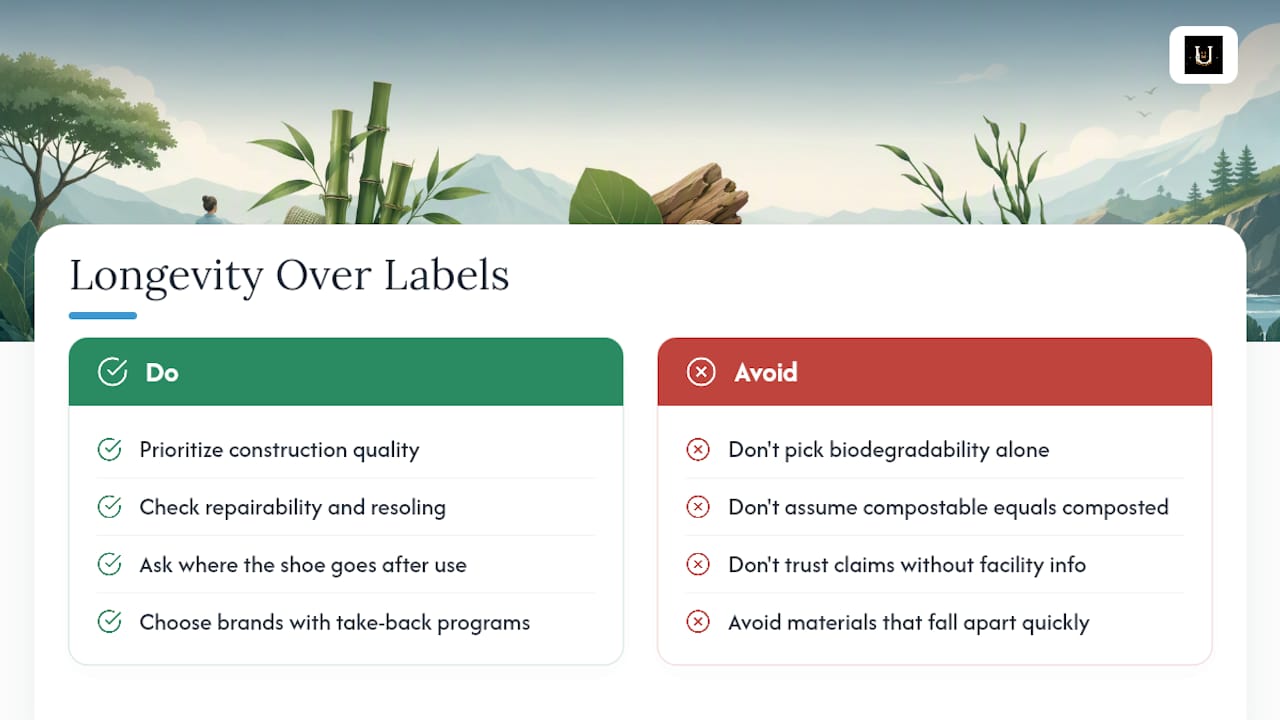
The conventional advice tells you to hunt for the “greenest” material. Better advice: hunt for the brand that tells you what happens to the shoe after year three. Does it come apart from natural fibers or synthetic ones? Can it be resoled? Is there a take-back option? Those questions matter more than whether the upper is pineapple fiber or recycled polyester.
Prioritize construction quality and material transparency first. Treat biodegradability as a bonus feature, not the deciding factor, unless the brand documents exactly where that shoe goes when you’re done with it.
— David
Get Cruelty-Free Boots Built to Actually Last
Some brands skip animal leather entirely without asking you to sacrifice the reinforced structure and grip you need boots to have. Many of these boots use vegan leather uppers, supportive ankle construction, and high-grip rubber soles made-to-order, so you’re not choosing between ethics and durability.
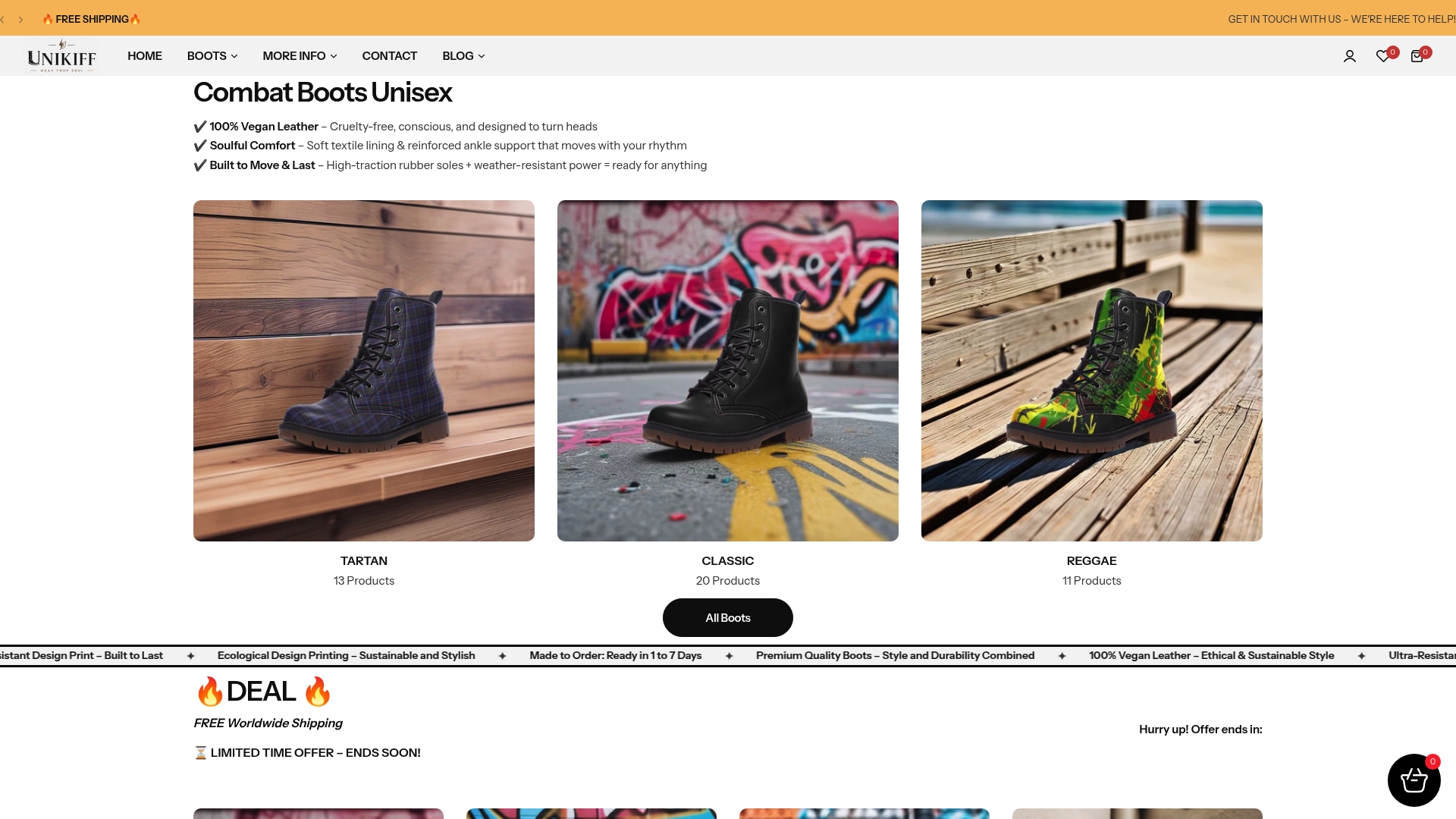
Browse the full vegan combat boots collection to find a silhouette that matches your style, from solid black and brown to bold gothic and punk prints. Unsure about sizing before you order? Check the size guide first to get the fit right on the first try, and start building a boot collection that holds up as long as your outfits do.
Sources
- Sustainable sneakers: Scientists create the world’s first biodegradable shoe
- A Sustainable Materials for Footwear Industry: Designing Biodegradable Shoes
- Closing the footwear loop (Fashion For Good case study)
- Korvaa shoes come to life using mycelium & biodegradable plastics
FAQ
What is the healthiest material for shoes?
Natural fibers like organic cotton, hemp, and lyocell tend to be the most breathable and least likely to irritate skin, since they avoid the synthetic coatings found in many recycled plastics.
What are the most eco-friendly shoe brands?
There’s no single answer, since it depends on which factor you weight most, recycled content, biodegradability, or repairability, but brands that document their full bill of materials and offer take-back or repair programs generally rank higher than those relying on one headline material claim.
What is a 100% vegan shoe?
Some combat boots are built entirely from vegan leather and synthetic components for this reason.
What’s the most eco-friendly material?
No single material wins outright. Recycled synthetics reduce waste but don’t biodegrade, natural fibers compost more easily but wear out faster, and bio-based leathers cut animal impact but often need a synthetic coating for durability, so the right choice depends on whether you’re prioritizing lifespan or end-of-life breakdown.