


Combat boots should lock your heel and midfoot in place while leaving about a finger’s width, roughly half an inch, of room in front of your longest toe. Snug isn’t the same as tight: your foot shouldn’t slide when you walk, but it also shouldn’t feel pinched at the widest part. Getting width and heel lock right matters far more than chasing a specific length, and sizing up to fix a narrow fit almost always backfires.
TL;DR:
- Proper fit emphasizes heel lock and toe clearance of about half an inch, with width and heel hold more critical than exact length.
- Measure your feet at the end of the day, both feet, using the wall-and-paper method or a Brannock device, and always verify against brand-specific size charts.
- Socks and insoles significantly affect internal volume, so always test boots with your actual daily footwear and orthotics before finalizing size.
- Most fit issues like blisters or heel slips can be corrected with simple lacing adjustments, orthotic changes, or half-size sizing up if needed.
- Leather boots tend to stretch over time, while vegan leather maintains its shape, making initial fit more crucial for synthetic materials over the long term.
Table of Contents
- How Should Combat Boots Fit? A 6-Step Check
- Measuring Your Feet the Right Way
- Why Width and Socks Matter More Than Length
- Fixing the Most Common Fit Problems
- Break-In Expectations and How to Verify Fit
- Where Unikiff Fits Into the Fit Conversation
- Boot Height and Ankle Support: The Overlooked Fit Variable
- How Leather and Synthetic Materials Change Fit Over Time
- A Style-Conscious Buyer’s Take on Fit First
- Find the Right Fit Before You Find Your Style
- Sources
- FAQ
How Should Combat Boots Fit? A 6-Step Check
Trying on a boot for thirty seconds in a store tells you almost nothing. Real fit reveals itself once you move, load up, and give your foot time to settle. Run through this sequence before you commit to a pair.
- Check heel lift. Walk a few steps, then tighten the laces and walk again. Heel movement beyond a minimal, slight amount signals a fit problem, not something you’ll “walk into.”
- Confirm toe room. With your foot pushed forward so toes touch the front, you want roughly half an inch of space behind your heel, matching the target most fitting guides recommend.
- Assess forefoot width. No crushing across the ball of your foot, and no bulging over the sides once laced.
- Test the instep hold. Fully laced, the boot should grip the top of your foot firmly without creating a pressure line.
- Wear your actual socks. Bring whatever socks, and any insoles, you plan to use daily. Thickness changes the internal volume more than most people expect.
- Move like you mean it. Walk, climb a step, crouch. Pressure points that hide while standing still show up fast once your foot flexes.
Tactical fitting guides put it bluntly: a properly sized boot should feel secure through the heel and midfoot while leaving room for your foot to swell over a long day. If you’re constantly aware of your boots, something’s off.
Measuring Your Feet the Right Way
Sneaker size is a guess when it comes to combat boots fit, not a starting point. Brands cut lasts differently, and the only way to size confidently is to measure your actual feet, then compare against the specific brand’s chart.
- Measure at the end of the day. Feet swell as hours pass, and fitting late in the day gives you a truer read than a morning measurement.
- Measure both feet, standing. Most people have one foot slightly larger than the other. Fit to the bigger one.
- Try the wall-and-paper method. Stand on a sheet of paper against a wall, mark the tip of your longest toe, then measure heel to mark for length.
- Use a Brannock device if you have access to one. It gives you length, width, and arch length in a single reading, which beats guessing at width from length alone.
- Record width, not just length. A “medium” length with the wrong width category is still the wrong boot.
- Cross-check against the brand’s own size chart rather than assuming your usual size carries over, especially when buying online, since model-specific fit notes can vary even within the same brand’s lineup.
Why Width and Socks Matter More Than Length
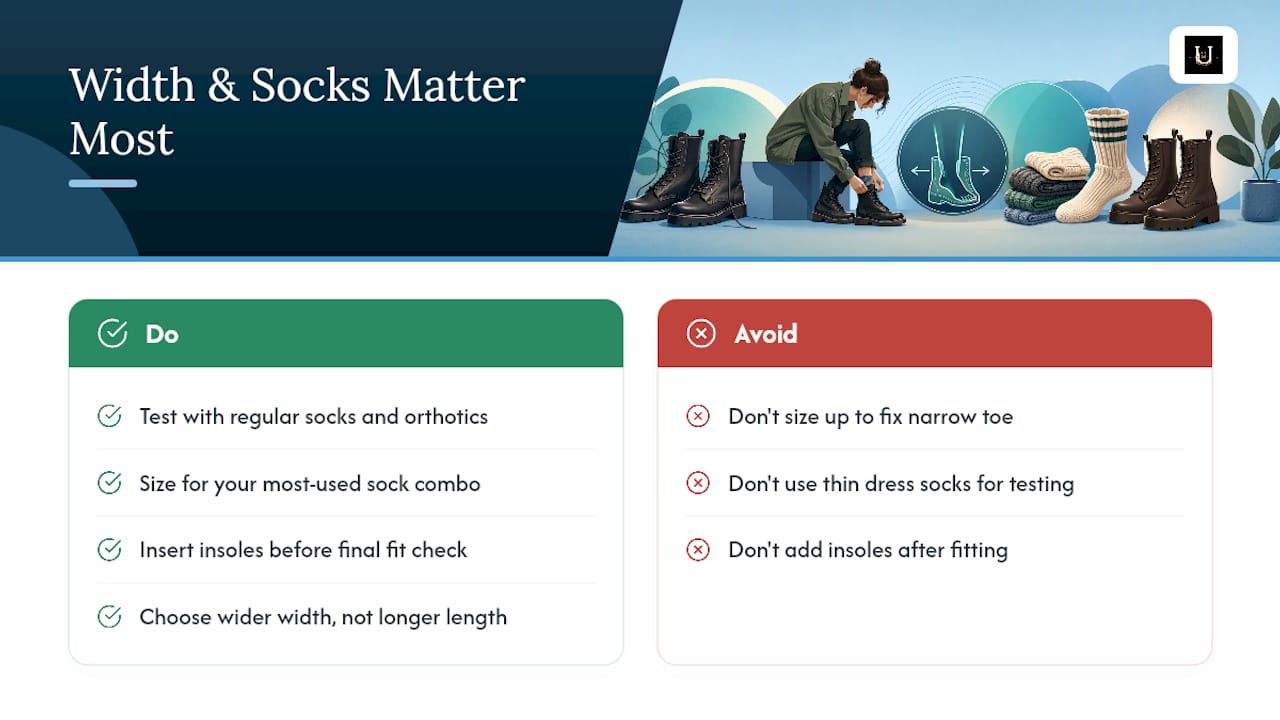
Most sizing complaints trace back to width or socks, not length. A boot that’s a hair long but correctly wide will outperform a “perfectly” sized boot with a cramped toe box every time.
Test your boots with the exact socks and orthotics you intend to wear, not a thin dress sock you grabbed for convenience. If you rotate between lightweight and heavyweight socks, size around whichever combination you wear most often, and accept that the other option might feel slightly looser or tighter. A narrow toe box needs a genuinely wider width, not extra length. Increasing length to fix narrowness usually causes poor fit and heel issues.
Pro Tip: Insoles eat into internal volume. If you’re adding a cushioned insole or orthotic, insert it before your final fit check. Boots that felt roomy enough without one can turn tight once you add support underneath your foot.
Fixing the Most Common Fit Problems
Most fit complaints have a fast, cheap fix before you reach for a return label.
- Blisters or hot spots: Adjust your lacing pattern first, add moleskin or friction tape to trouble spots, and switch to moisture-wicking socks if you’re still wearing cotton.
- Heel slip: Try lock-lacing (crossing laces through the top eyelets to create a locking loop) before assuming the boot is wrong. Heel pads help too, and if slip persists after both fixes, drop half a size or try a narrower width.
- Toe impact on downhills or stairs: Confirm you actually have that half inch of room. If width and last shape are correct but toes still hit the front, size up in length only, not width.
- Instep pressure: Loosen or restructure your lacing pattern over the sore spot, swap to a thinner insole, or accept that this particular last shape doesn’t match your foot and try a different model.
Break-In Expectations and How to Verify Fit
New boots need a runway, not a marathon. Rushing straight into a full day of wear is how minor fit issues turn into real injuries.
- Start with short walks. Thirty minutes to an hour on day one, gradually extending as the leather or synthetic upper flexes to your foot shape.
- Expect minor heel movement. Movement up to a quarter inch when boots are new is normal and often shrinks as the insole compresses to your foot.
- Test under real conditions. Stairs, inclines, and a loaded pack (if that’s your use case) reveal pressure points flat ground never will.
- Watch for a hard fail. Persistent heel float after lacing, or sharp pain that doesn’t ease after several wears, means the size or last doesn’t match your foot. Don’t force it. Use your return or exchange window instead.
Where Unikiff Fits Into the Fit Conversation
Unikiff builds its vegan combat boots around the same structural priorities this guide walks through: lace-up closures that let you fine-tune instep hold, supportive ankle structure, reinforced stress points, and high-grip rubber soles built for actual wear, not just display.
- The boots use cruelty-free vegan leather, and some are made to order, combining ethical materials with support features typical of combat boots.
- The lace-up design allows for adjustments such as lock-lacing and pressure-relief techniques to improve fit after purchase.
- Reinforced ankle structure contributes to stability, an important factor alongside toe room during extended wear.
The measurement and movement tests in this guide apply whether you’re shopping tactical gear or a bold printed pair for a festival look. Fit standards don’t change because the design does.
Boot Height and Ankle Support: The Overlooked Fit Variable
Height changes what “good fit” even means. A low-cut boot relies almost entirely on lacing and heel shape to stay secure, since there’s no upper shaft to help hold your foot in place. A mid or tall shaft, by contrast, adds ankle support but introduces a second fit zone you need to check separately from the foot itself.
If the shaft is too tight around your calf or ankle bone, you’ll get pressure points that have nothing to do with your foot measurements. Too loose, and the boot can rock side to side even when your heel is locked, which undermines the ankle support the height was supposed to provide in the first place. When trying on taller boots, flex your ankle forward and roll it slightly side to side. A well-fitted shaft moves with you instead of staying rigid or shifting independently.
Boot purpose matters here too. Matching your boot’s height and outsole to your intended use, whether that’s patrol work, everyday city wear, or festival standing, changes how much ankle support you actually need versus how much flexibility you’d rather keep. A taller shaft that feels supportive on uneven terrain can feel restrictive if you mostly need to move quickly on flat pavement.
How Leather and Synthetic Materials Change Fit Over Time
Fit isn’t fixed the day you buy the boots. Materials shift shape as they wear in, and how much they shift depends on what they’re made of.
Genuine leather stretches and molds to your foot over weeks of wear, which is why leather boots often feel slightly firm on day one but loosen at the flex points and toe box over time. That’s useful if your boot runs a touch snug in width, but it also means a leather boot that fits loose out of the box will likely get looser, not tighter.
Vegan leather and other synthetic uppers behave differently. They generally hold their shape more consistently, with less dramatic stretch than natural leather, which means the fit you get on day one is closer to the fit you’ll have months later. That consistency is an advantage for buyers who want predictable sizing without guessing how much a material will give. It also means synthetic uppers reward getting the initial fit right, since you can’t count on significant break-in stretch to bail you out of a boot that’s genuinely too tight through the width.
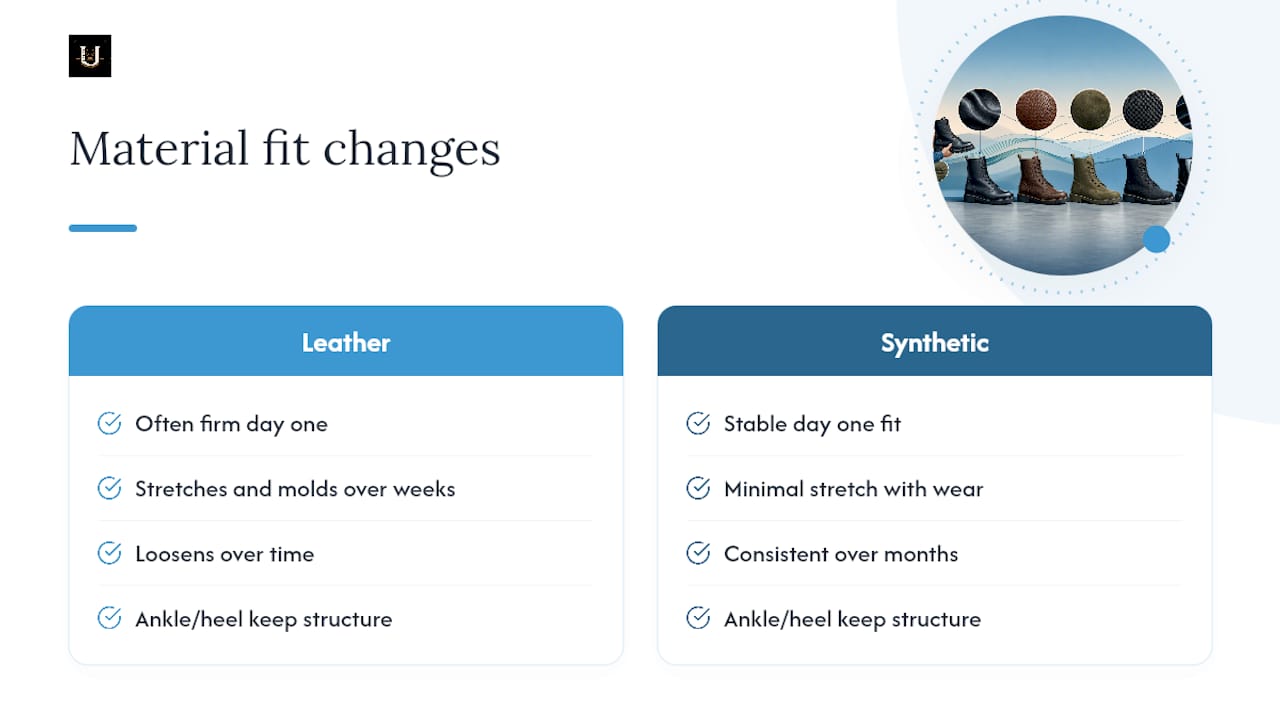
Either way, the reinforced details around the ankle and heel tend to hold their structure regardless of upper material, which is where most of your actual support comes from.
A Style-Conscious Buyer’s Take on Fit First
Fit comes before fashion, full stop. A bold print or a striking colorway means nothing if the boot pinches your toe box or lets your heel slide with every step. Run the same checks, whether you’re eyeing a solid black pair or a printed design: heel lock, width, that half inch of toe room.
Skip decorative modifications that interfere with lacing or structural support. A boot that fits well gives you far more freedom to experiment with styling it up or down than one you’re constantly adjusting.
— David
Find the Right Fit Before You Find Your Style
Once you know your measurements and you’ve run through the fit checks above, matching them to an actual boot should take minutes, not guesswork. Unikiff’s size guide walks you through converting your foot measurements into the right Unikiff size, so you’re not stuck comparing charts across five different brands.
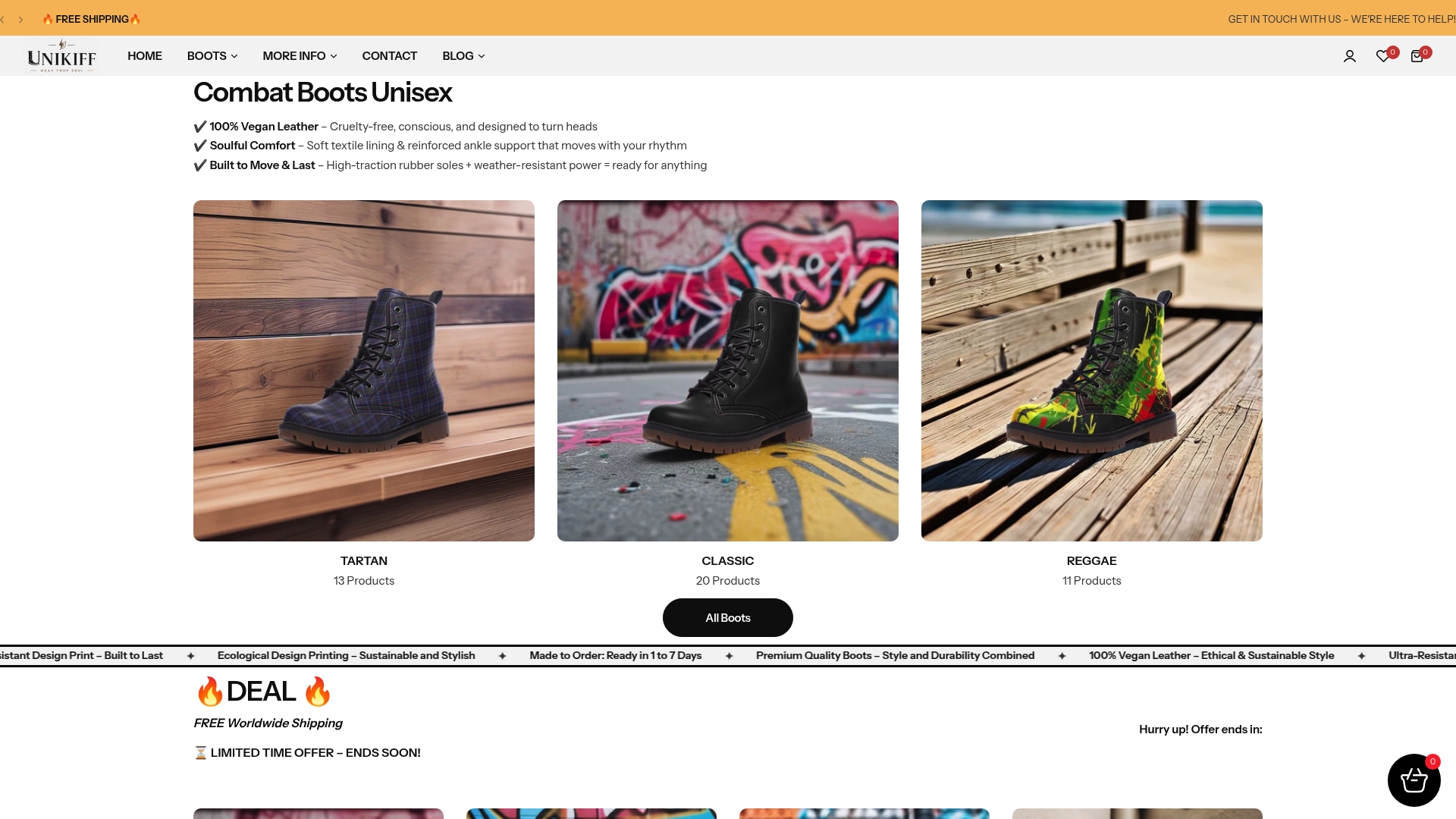
From there, browse the full vegan combat boots collection, from solid black and brown pairs to bold gothic and punk prints, all built with the same lace-up structure, reinforced ankle support, and high-grip soles this guide covers. If a pair doesn’t fit as expected upon arrival, a return and exchange process is typically available to avoid keeping uncomfortable boots. For questions about sizing or style fit, customer service can often help guide the purchase decision.
Sources
- Boot Fit Guide — Marine Corps OCS
- How to Size Tactical Boots Properly — JustGoodKit
- How to choose military boots: a guide — Garmont Tactical
FAQ
Is it better to size up or down for combat boots?
Neither, by default. Fit to your actual measured length and width rather than defaulting up or down, since sizing up to fix narrowness usually creates heel slip instead of solving the original problem.
What size combat boots do I need?
Measure both feet at the end of the day using the wall-and-paper method or a Brannock device, then match those numbers to the specific brand’s size chart rather than assuming your sneaker size carries over.
What are the disadvantages of combat boots?
Poorly fitted combat boots can cause blisters, heel slip, and instep pressure, and even correctly fitted pairs need a break-in period before long wear feels comfortable. Choosing the wrong width instead of the wrong length is the most common cause of ongoing discomfort.
How long do combat boots take to break in?
Most people need several short wear sessions, starting with half an hour and gradually increasing, before boots feel fully settled. Minor heel movement up to a quarter inch is normal early on and typically fades as the insole and upper mold to your foot.
Do vegan combat boots fit the same as leather ones?
Vegan leather uppers tend to hold their shape more consistently than genuine leather, with less dramatic stretch over time, so the fit you get initially is closer to what you’ll have months later. That makes getting the width and length right at purchase even more important with synthetic materials.