


A combat boot works because ten distinct parts do ten distinct jobs at once: the outsole grips, the midsole absorbs shock, the shank fights torsion, the lasting board holds the whole structure together, and the upper, membrane, lining, shaft, tongue, and toe/heel assemblies handle protection, waterproofing, and ankle control. Understanding how these pieces cooperate is the difference between buying a boot that looks tough and one that actually performs.
TL;DR:
- The outsole’s lug pattern and rubber compound determine traction and durability, with deep lugs suited for mud and softer compounds providing better grip.
- The midsole’s shock absorption relies on materials like EVA or PU, where PU offers longer-lasting cushioning, especially in heavy-duty use.
- A stiffer shank enhances torsional stability and reduces fatigue on rough ground but can limit flexibility on technical terrain.
- Construction methods like welted are more repairable and durable, while cemented and direct-injected options are lighter and cheaper but less sustainable long-term.
- Vegan combat boots use similar structural parts, such as reinforced uppers and supportive shafts, but prioritize weight, cruelty-free materials, and urban versatility over heavy field durability.
Table of Contents
- Combat Boot Anatomy: The Boot as an Engineered System
- Outsole: Tread, Lug Pattern, and Traction
- Midsole: Shock Absorption and Cushioning Materials
- Shank: Torsional Stability and Arch Support
- Structural Insole vs. Removable Footbed: What’s the Difference?
- Upper Construction: Leather, Synthetics, and Hybrid Materials
- Membrane and Lining: Waterproofing and Moisture Control
- Shaft, Tongue, and Lacing System: Fit and Ankle Support
- Toe Puff and Heel Counter: Built-In Protection
- Construction Methods: Welted, Cemented, and Direct-Injected
- Fit and Care: Matching Anatomy to Your Needs
- Brand Note: How Vegan Combat Boots Map to This Same Anatomy
- Author Perspective: Prioritize by Use Case, Not Hype
- Find Your Next Pair: Unikiff’s Vegan Combat Boot Collections
- Sources
- FAQ
Combat Boot Anatomy: The Boot as an Engineered System
Every combat boot splits into two connected systems: the sole stack underfoot and the upper wrapped around your foot and ankle. The sole stack (outsole, midsole, shank, and structural insole) handles ground contact, shock absorption, and stability. The upper system (leather or synthetic panels, membrane, lining, shaft, and lacing) handles fit, protection, and weather resistance. Neither system works well in isolation. A grippy outsole paired with a collapsed midsole still transmits every rock straight into your heel. A waterproof membrane inside a poorly gusseted tongue still lets water in through the lace channel.
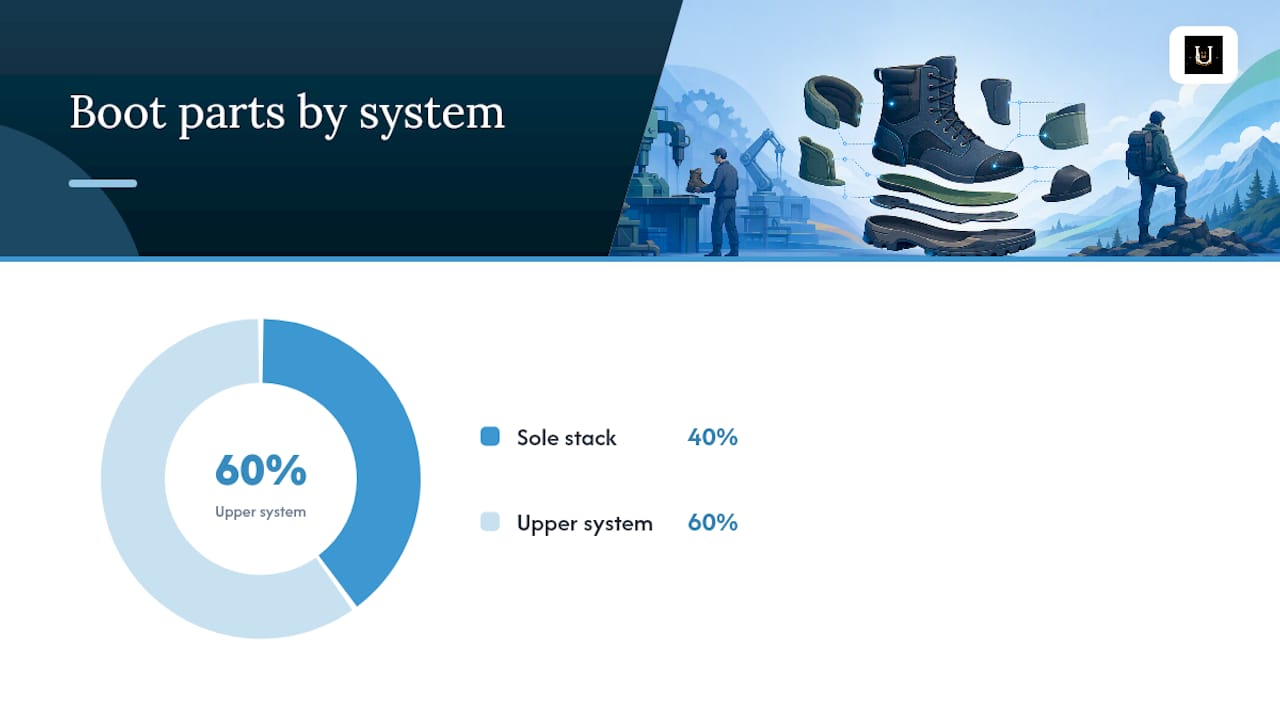
This ten-part structure, outsole, midsole, shank, structural insole, removable footbed, upper, membrane, lining, shaft, and tongue, shows up consistently across technical breakdowns of military boot construction. Shaft height is one of the first things you’ll notice varies boot to boot, typically running 4 to 8 inches from the outsole — you can find tips on how to style this feature effectively in everyday looks at How to style Christian streetwear boldly. Shorter shafts move faster and breathe better; taller shafts lock the ankle down and seal out debris, which is why tactical designs skew toward the top of that range.
The interactions matter more than any single part:
- The outsole and midsole together determine how much impact reaches your joints.
- The shank and lasting board together determine how the boot resists twisting on uneven ground.
- The membrane and lining together determine whether your feet stay dry from the outside in or the inside out.
- The shaft and tongue together determine how well the whole upper seals against water, grit, and cold.
Outsole: Tread, Lug Pattern, and Traction
The outsole is the only part of the boot that touches the ground, and its lug pattern decides whether you stay upright on wet pavement, loose gravel, or mud. Deep, widely spaced lugs typically shed mud and debris as you walk, a trait boot engineers call self-cleaning. Shallow, tightly packed lugs grip better on hard, dry surfaces like concrete or tile but clog fast in soft terrain.
Rubber compound matters just as much as lug depth. Vulcanized rubber is the workhorse: durable, resistant to oil and abrasion, and cheap enough to keep boot prices reasonable. Vibram and other proprietary rubber blends push further, often mixing in compounds tuned for grip at low temperatures or on wet rock. The tradeoff is stiffness. Harder compounds outlast softer ones but sacrifice some traction feel, while softer compounds grip better but wear down faster under daily use.
Sole-unit thickness ties directly to lug depth and overall durability. Anatomy breakdowns of military-style boots note that thicker outsole units generally last longer and handle rougher terrain, at the cost of added weight and a higher stance that can affect balance on technical ground.
Pro Tip: Check the lug pattern before you check the brand name. A boot with fine, closely packed tread is built for city sidewalks and festival grounds, not muddy trails, no matter how tough it looks.
Some military and tactical footwear specifications reference dimensional and material limits that shape how outsoles are built and labeled, a legacy of uniform and appearance regulations like AR 670-1 that still influence how combat-style boots are marketed today.
Midsole: Shock Absorption and Cushioning Materials
If the outsole is the boot’s grip, the midsole is its suspension system, and it’s the component most buyers overlook. The midsole sits between the outsole and the structural insole, and its job is to absorb impact before it reaches your joints.
Two materials dominate: EVA (ethylene vinyl acetate) and PU (polyurethane). Each behaves differently under load:
- EVA is lightweight and cushions well immediately out of the box, making it a favorite for boots meant to feel comfortable on day one.
- PU is denser and heavier but compresses more slowly over time, holding its shock-absorbing properties through months of hard use.
- EVA tends to pack down and lose bounce faster, especially under repeated heavy loads.
- PU costs more to produce but delivers better long-term compression resilience, which is why heavier-duty boots often lean on it.
Midsole geometry compounds these material differences. A wider, thicker midsole spreads impact force over more surface area, reducing joint stress on hard pavement. A narrower, low-profile midsole feels more responsive underfoot but transmits more shock on repeated impact.
One overlooked detail: the midsole is frequently the unsung hero of boot comfort, doing more to prevent fatigue than the leather or fabric you actually see on the upper. When a midsole starts feeling flat or noticeably firmer than when the boots were new, that’s compression setting in permanently, not a sign the boots just need breaking in again. At that point, cushioning performance has dropped for good, even if the outsole tread still looks fine.
Shank: Torsional Stability and Arch Support
The shank is a rigid or semi-rigid piece embedded in the sole between the heel and the forefoot, and its entire job is preventing the boot from twisting under your foot. Without one, a boot flexes wherever it’s weakest, usually right under the arch, which fatigues your foot faster on uneven ground.
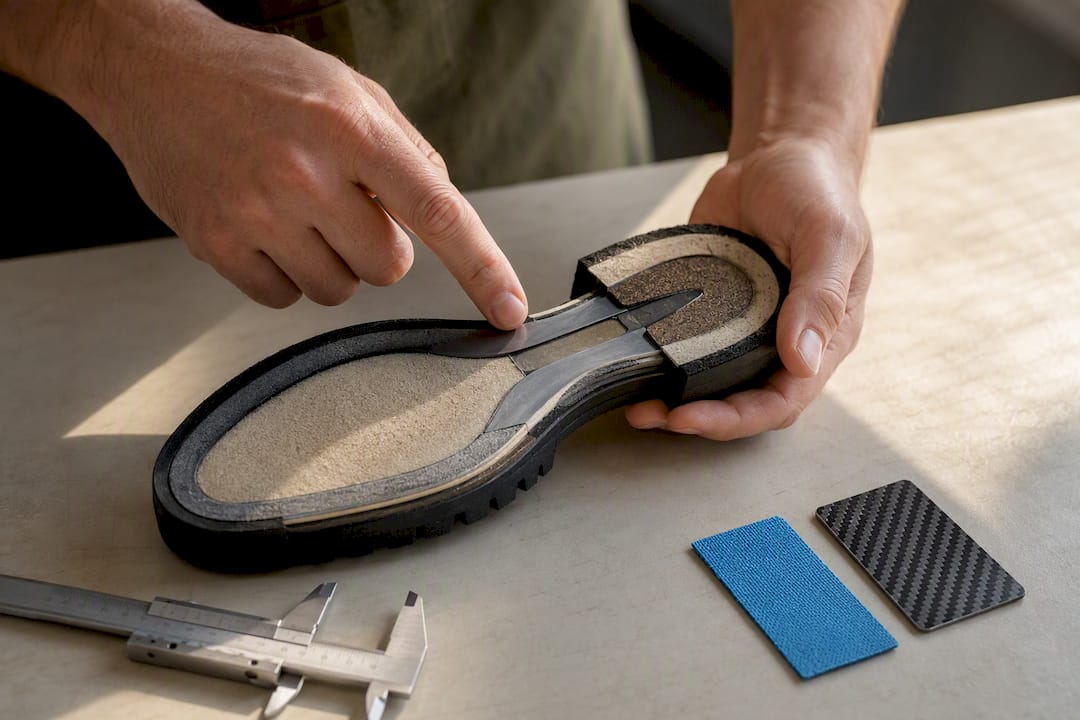
Material choice changes how that support feels. Steel shanks offer maximum rigidity and have long been standard in heavy-duty work and military boots, but they set off metal detectors and add noticeable weight. Composite and fiberglass shanks solve both problems, delivering comparable torsional rigidity) at a lighter weight, which is why many tactical roles now favor composite over steel specifically to avoid detection issues. Nylon shanks sit at the flexible end of the spectrum, offering some arch support with less bulk, better suited to lighter-duty boots than heavy field use.
Shank stiffness also affects fatigue over a long day. A stiffer shank reduces the small muscular effort your foot makes to stabilize itself with every step, which adds up over miles. That stiffness becomes a liability on technical terrain requiring foot flexibility, where a slightly softer shank actually performs better.
Structural Insole vs. Removable Footbed: What’s the Difference?
These two parts get confused constantly, and the confusion costs buyers money. The structural insole, also called the lasting board, is a rigid layer built into the boot during construction. It’s the actual skeleton the rest of the boot is built around, and you cannot remove it without disassembling the boot itself.
The removable footbed, sometimes called the sockliner, is the cushioned insert you can pull out and replace. It sits directly under your foot and handles moisture-wicking, cushioning, and day-to-day comfort.
This distinction matters because the lasting board is a far more reliable indicator of long-term boot quality than the footbed. A worn-out footbed is a five-minute fix. A degraded lasting board means the boot’s structural integrity is failing, and no insert swap solves that. When you’re evaluating a boot’s durability, the lasting board tells the real story.
Footbed materials vary by intended use. Foam-based footbeds prioritize comfort and moisture absorption for everyday wear. Some are treated with antimicrobial layers to control odor over repeated wear. Because the footbed is replaceable, it’s also the easiest anatomical component to upgrade after purchase if the stock version doesn’t fit your foot the way you’d like.
Upper Construction: Leather, Synthetics, and Hybrid Materials
The upper is everything wrapped around your foot above the sole, and material choice here drives the biggest tradeoffs in durability, weight, and breathability. Three broad categories dominate the market:
- Full-grain leather offers the best long-term durability and molds to your foot over time, but it’s heavy, slower to break in, and requires ongoing conditioning to resist cracking.
- Nylon and Cordura blends cut weight dramatically and breathe better in warm conditions, but they abrade faster than leather under repeated contact with rough surfaces.
- Vegan and synthetic leathers close much of that durability gap while skipping animal materials entirely, and modern versions hold up well to daily wear without the break-in period leather demands.
Beyond the base material, structural overlays reinforce the areas that fail first: the toe box, the heel, and the eyelet rows where lace tension concentrates stress. Stitching quality and welt construction (where the upper meets the sole) directly affect how long those reinforced zones hold up before separating from the base material.
What you should prioritize depends entirely on how you’ll use the boots. Daily urban wear favors lighter synthetic uppers that flex easily and don’t demand conditioning. Heavy outdoor or occupational use favors leather or reinforced hybrids that shrug off abrasion. Style-focused wear, festivals, layered outfits, statement looks, can prioritize whichever material delivers the aesthetic you want, since daily abrasion resistance matters less than it does for fieldwork.
Membrane and Lining: Waterproofing and Moisture Control
A waterproof-breathable membrane is a thin layer sandwiched inside the upper that blocks liquid water from entering while still letting sweat vapor escape outward. Gore-Tex is the best-known example, but several equivalent membrane technologies achieve similar results using microporous or hydrophilic construction. The rate at which vapor escapes is measured as MVTR (moisture vapor transmission rate), and higher MVTR generally means a drier foot during extended wear.
Lining sits between the membrane and your foot, and its material determines day-to-day comfort. Wicking synthetic linings pull sweat away from skin to reduce blister risk, a small design detail that makes a real difference in field conditions over long wear periods. Membrane boots need specific care: harsh detergents and high heat can degrade the membrane’s pores over time, so gentle cleaning and air drying preserve waterproof performance far longer than tossing them in a machine wash.
Shaft, Tongue, and Lacing System: Fit and Ankle Support
Shaft height determines how much ankle control and coverage a boot provides. Low shafts (around 4 to 5 inches) move lighter and flex more naturally for everyday walking. Mid and tall shafts (6 to 8 inches) lock the ankle down and seal out debris, water, and cold, at the cost of some flexibility and break-in time.
The tongue’s construction affects sealing just as much as shaft height does. A gusseted tongue, stitched to the upper along both sides, closes the gap that would otherwise let water and grit into the boot through the lace area. An ungusseted tongue is easier to slip on and off but leaves that entry point exposed.
Lacing hardware changes how pressure distributes across your foot:
- Speed hooks near the top allow fast lacing and unlacing, common on taller shafts.
- D-ring or flat eyelets distribute lace tension evenly across the lower foot, reducing hot spots.
- Metal grommets resist wear better than fabric eyelets but add small amounts of weight.
Getting this system right is often what separates a boot that feels supportive from one that just feels tight.
Toe Puff and Heel Counter: Built-In Protection
The toe puff is a stiffened material built into the front of the upper that holds its shape and resists impact, distinct from a true composite or steel toe cap, which is a rigid, load-bearing insert meeting formal safety standards. Boots marketed for job sites or hazard environments should specify which one they use, since a soft toe puff offers shape retention, not certified impact protection. When safety certification matters, ASTM standards define the actual testing thresholds for protective toe performance, and a boot without that certification shouldn’t be treated as safety-rated no matter how sturdy the toe feels.
The heel counter, a firmer structural cup at the back of the boot, keeps your heel aligned and prevents side-to-side slippage that causes blisters. It also reinforces the area that takes the most repeated stress from walking. Both components add weight, and in cold climates, metal toe caps specifically can conduct cold into the boot, a real tradeoff for anyone choosing heavy protection in freezing conditions.
Construction Methods: Welted, Cemented, and Direct-Injected
How the upper attaches to the sole affects everything from repairability to weather resistance. Three methods cover most combat and tactical boots on the market:
- Welted construction stitches the upper, insole, and outsole together through a welt strip, making the boot fully resolable and generally the longest-lived option.
- Cemented construction bonds the upper to the sole with adhesive, which cuts cost and weight but makes resoling difficult or impossible once the bond fails.
- Direct-injected (DI) construction molds the sole directly onto the upper, creating excellent waterproofing at the seam but sacrificing repairability almost entirely.
The tradeoff is consistent across all three: a welted boot generally outlasts the alternatives and can be rebuilt indefinitely, while cemented and injected boots cost less upfront and often weigh less, but they’re built to be replaced rather than repaired.
When you’re reading a product description, look for explicit mentions of the construction method, resoling capability, or welt type. Vague language like “durable construction” without naming the actual method is usually a sign the boot uses the cheaper cemented approach.
Fit and Care: Matching Anatomy to Your Needs
Matching a boot’s anatomy to your actual use case starts with three questions: how much sole stack and shank stiffness do you need, and how tall a shaft makes sense for your day-to-day?
- Daily urban wear favors a moderate sole stack, a flexible composite or nylon shank, and a lower shaft for natural movement.
- Festival or styling use can prioritize aesthetics and a comfortable break-in over maximum shank stiffness, since you’re rarely covering rough terrain.
- Heavy-load or long-duration use calls for a stiffer shank, a thicker EVA or PU midsole, and a taller, gusseted shaft for support and sealing.
Fit itself ties directly back to anatomy. A properly fitted boot locks your heel against the heel counter with minimal lift, leaves roughly a thumb’s width of room at the toe puff, and shouldn’t require aggressive lacing to eliminate slippage.
Pro Tip: If you’re between sizes, size toward a slightly roomier toe box rather than a tighter heel. A loose heel causes blisters fast, but a snug toe puff softens with wear.
Basic care extends the life of every component discussed above: condition leather uppers every few months, air-dry membrane boots away from direct heat, and replace the removable footbed once it feels flat, well before the midsole itself needs attention.
Brand Note: How Vegan Combat Boots Map to This Same Anatomy
Every anatomical principle above applies just as directly to vegan combat boots. Some vegan leather boots are built with reinforced overlays at the toe and heel, a supportive ankle shaft, and high-grip rubber outsoles for everyday traction. Vegan leather uppers trade some of full-grain leather’s decades-long break-in durability for lighter weight, no animal materials, and zero conditioning maintenance. The practical result is a boot built for city wear, festivals, and statement outfits rather than heavy fieldwork, with the same structural logic, lasting board, midsole cushioning, ankle support, applied to cruelty-free materials.
Author Perspective: Prioritize by Use Case, Not Hype
Most buyers chase leather quality or brand reputation and skip the two parts that matter most: the midsole and the shank. For daily urban wear, prioritize a cushioned midsole and moderate ankle support over maximum toe protection you’ll never need. For festival or styling use, comfort and shaft fit matter more than shank rigidity. For genuinely heavy-load work, accept the weight penalty of a stiffer shank and taller shaft. Weight and protection trade off directly. Buying more of one always costs you the other.
— David
Find Your Next Pair: Unikiff’s Vegan Combat Boot Collections
Some vegan combat boots are designed with reinforced toe and heel structure, supportive ankle shafts, and high-grip rubber outsoles, without animal-derived materials. That’s the real difference here. You get the structural performance of traditional combat boot construction with cruelty-free vegan leather uppers and bold designs mass-market stores simply don’t carry.
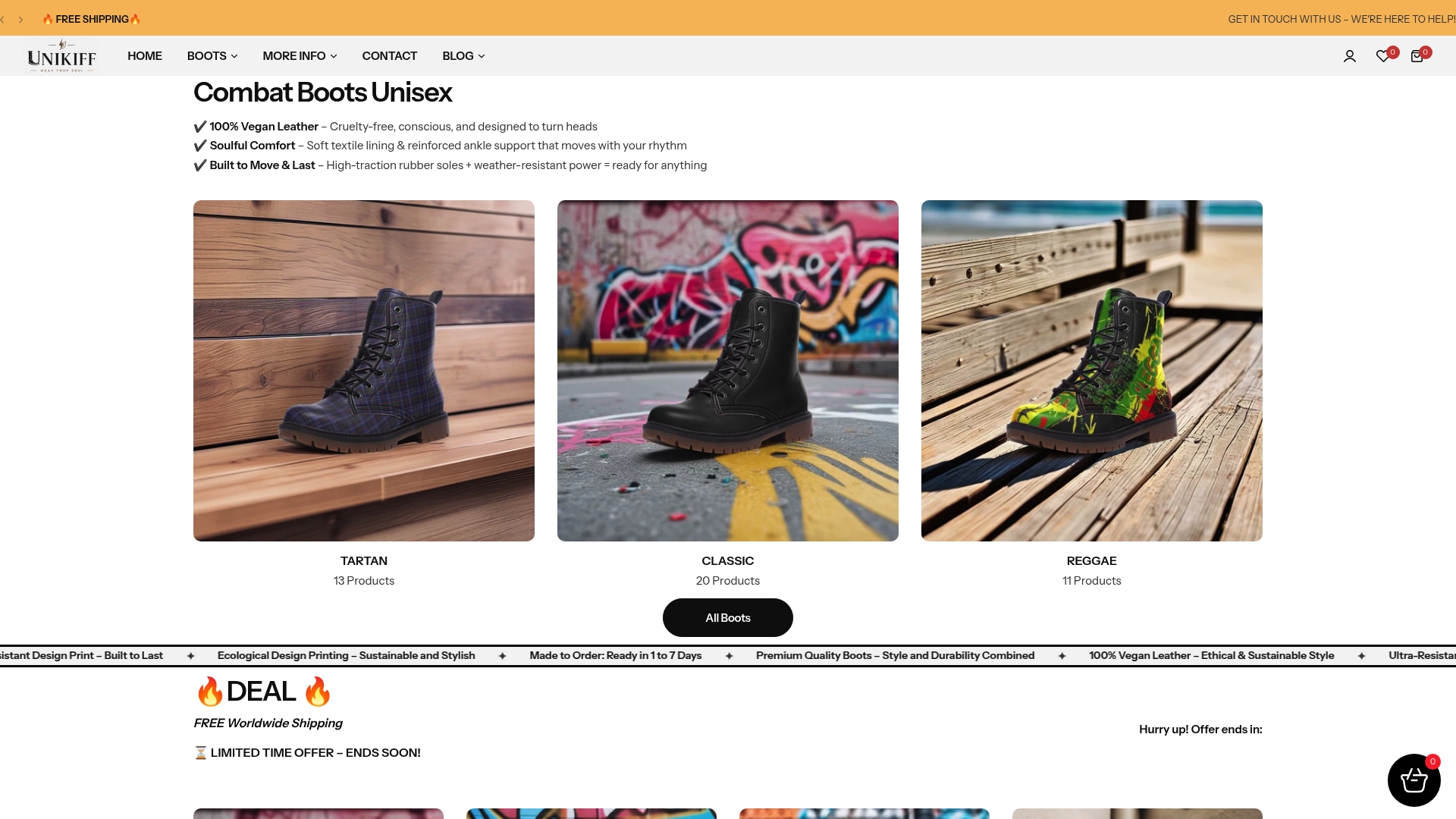
If durability and ankle support are your top priority, start with the Classic Combat Boots collection for a timeless, solid-color build. If you’re shopping for a statement look, the Punk Combat Boots and Skull Combat Boots lines bring bold prints without sacrificing the reinforced shaft and lacing structure covered above. Before you check out, run your measurements against the vegan combat boots size guide to match shaft height and toe room to your foot, exactly the fit factors this guide covers. Browse the full range at Unikiff’s boot collections and pick the pair whose anatomy actually matches how you plan to wear it.
Sources
- Anatomy of a Military Boot: What Is Inside a Combat Boot? — Raff
- ASTM International — standards body
FAQ
What Makes a Boot a Combat Boot?
A combat boot is defined by its tall, supportive shaft, reinforced toe and heel construction, and a durable lace-up closure designed for ankle stability on varied terrain. The core anatomy, outsole, midsole, shank, and structural insole, is what separates it functionally from a casual boot, as detailed anatomy breakdowns confirm.
What Are the Different Parts of a Boot Called?
The main parts are the outsole, midsole, shank, structural insole (lasting board), removable footbed, upper, membrane, lining, shaft, tongue, and the toe puff and heel counter. Each has a distinct job, from traction at the outsole to torsional support from the shank.
What Does a Combat Boot Look Like?
A combat boot typically has a rounded or slightly reinforced toe, a lace-up front running through several eyelets or hooks, a shaft that rises 4 to 8 inches above the ankle, and a thick, lugged rubber outsole. Unikiff’s vegan versions follow that same silhouette, adding bold prints or solid colors depending on the collection.
Why Do Combat Boots Have Heels?
Combat boots have a slightly raised heel to improve stability on uneven terrain and to help lock the foot against the heel counter, reducing slippage during movement. That raised heel also works with the shank to distribute impact more evenly across the sole rather than concentrating it under the arch.