


Some vegan boots are genuinely breathable, and many aren’t, depending on the material, the coating, and how the whole boot is built. The short answer: check for mesh panels, named breathable membranes like AQUAIR®, or published MVTR numbers before you buy. Our combat boots feature comfort details like supportive linings and reinforced panels built in, so you’re not left guessing.
TL;DR:
- Breathability depends on materials, coatings, and construction, with open meshes and membranes like AQUAIR® offering the best airflow.
- Lab-tested MVTR numbers and visible vent panels indicate higher moisture escape potential, but real-world comfort also relies on liners and activity level.
- Coatings and laminates, often added for water resistance, typically reduce breathability compared to untreated or engineered fiber options.
- Proper construction involves moisture-wicking linings and system design, as sealed membranes can trap moisture even with breathable upper materials.
- Maintenance habits like drying boots properly and using breathable socks help preserve breathability, especially in sealed or coated vegan footwear.
Table of Contents
- How breathability is measured and what the numbers mean
- Material-by-material breathability: plant leathers, microfiber synthetics, PU, and mesh
- Why construction and lining matter more than you think
- Practical buying checklist for breathable vegan boots
- Care and quick fixes to keep your boots breathable
- What we believe about comfort, ethics, and tradeoffs
- Find Unikiff’s comfort-focused vegan combat boots
- FAQ
- Sources
How breathability is measured and what the numbers mean
Breathability in footwear comes down to two measurements: moisture vapor transmission rate (MVTR) and air permeability. MVTR tracks how much water vapor passes through a material over a set time and area, basically how fast sweat can escape before it pools against your foot. Air permeability measures how easily air itself moves through the fabric or coating. Both matter for comfort, but they measure slightly different things.
Labs commonly use the EN ISO cup test to generate MVTR figures, sealing a sample over a cup of water or desiccant and tracking weight change under controlled humidity and temperature. These numbers are useful for comparing materials side by side, but real-world comfort also depends on sock choice, activity level, and weather, so lab figures set expectations rather than guarantees.
- MVTR tells you how fast moisture escapes through a material.
- Air permeability tells you how easily air itself passes through.
- EN ISO cup tests are the standard lab method for generating these numbers.
Research shows regulating foaming ratios in superfine fiber synthetic leather can push MVTR as high as 1,992.93 g/(m²·24 h) at a 300% foaming ratio, compared with conventional PU-laminated leather, which typically sits below 800 g/(m²·24 h). That gap shows manufacturing choices can matter more than whether a material is labeled “vegan” or “leather” in the first place.
Material-by-material breathability: plant leathers, microfiber synthetics, PU, and mesh
Not all vegan uppers perform the same way, and the differences come down to structure, not ethics claims. Open textile meshes and some engineered microfiber synthetics tend to score highest for airflow, plant-based materials like Piñatex land in the middle, and conventional PU-laminated faux leather usually ranks lowest once a dense protective coating goes on.
- Open mesh and engineered microfiber synthetics: typically the most breathable vegan upper options.
- Plant-based leathers like Piñatex: moderate breathability, reduced once coated.
- Conventional PU-laminated faux leather: often the least breathable due to dense surface coatings.
Coatings and laminates are usually added to boost water resistance or durability, and that extra layer is exactly what blocks vapor from escaping. A comparative material study testing Desserto, Piñatex, Muskin, and other alternatives found that none matched leather’s all-around performance: some allowed decent vapor diffusion but lacked mechanical flex strength, pushing manufacturers toward reinforcing coatings that cut breathability in exchange for durability.
Plant-based leathers like Piñatex offer moderate breathability thanks to their fibrous structure, but the polyurethane coatings often applied for strength and water resistance reduce that airflow compared with untreated fiber. Meanwhile, a 2026 materials engineering study found that optimizing TPU nanofiber structure and foamed waterborne polyurethane adhesive parameters, specifically a 15% mass fraction, 150 micron coating thickness, and 300% foaming ratio, produced high air permeability alongside MVTR figures well above standard PU-laminated leather. Even mycelium-based composites can compete: a 2025 study on superfine mycelium fiber textile recorded roughly 68.9% porosity with strong moisture-wicking and drying behavior, suggesting bio-based alternatives can rival synthetics when engineered for airflow rather than just marketed as “natural.”
For a deeper look at how these materials are sourced and processed, our breakdown of sustainable materials for vegan leather footwear covers the tradeoffs in more detail.
Why construction and lining matter more than you think
A breathable upper doesn’t guarantee a breathable boot. Breathability only works as a system: the lining, membrane, seams, and insole all have to let moisture through, or the most advanced upper material in the world won’t help your feet stay dry.
- The lining acts as a transport layer, wicking sweat away from your skin toward the outer material so it can escape.
- Sealed waterproof membranes, heavy seam taping, and non-wicking plastic liners can trap moisture even when the upper itself is porous.
- Systems like AQUAIR® use a microporous PU membrane specifically engineered to stay permeable to water vapor while still repelling liquid water, showing that waterproofing and breathability aren’t automatically opposites when the whole system is designed together.
Without a wicking lining, moisture tends to pool right at the foot, no matter how good the upper fabric is on paper, since the transport layer is what actually moves sweat along.
Pro Tip: Look for linings described as “moisture-wicking” or “sport mesh” rather than just “soft lining,” since that phrasing usually signals an actual transport layer.

Practical buying checklist for breathable vegan boots
Shopping for breathable vegan boots gets easier once you know what to scan for on a product page or in person. A few consistent signals separate boots designed for comfort from ones that just look the part.
- Published MVTR or air-permeability specs, or at least a mention of breathable technology.
- Named breathable systems, like AQUAIR® membranes, rather than vague “waterproof” claims.
- Visible mesh, vent panels, or perforations in photos, not just solid coated panels.
- A moisture-wicking or sport-mesh liner instead of a plain plastic-feeling lining.
- A removable insole, which lets you swap in a breathable topper later if needed.
Fit matters too: a snug toe box traps heat and increases sweating, so leave a little room, especially if you plan to wear thicker socks. If you mainly need boots for wet climates or long outdoor days, prioritize water resistance over breathability. For everyday city wear, festivals, or indoor-heavy days, breathability usually matters more than full waterproofing.
Care and quick fixes to keep your boots breathable
A few habits go a long way toward keeping any vegan boot feeling fresh. Let boots dry fully between wears, rotate pairs so moisture has time to evaporate, and choose breathable socks over synthetic blends that trap heat.
- Dry boots at room temperature, away from direct heat, and avoid sealing them in airtight bags or boxes.
- Add a moisture-wicking insole or a perforated orthotic topper if the stock insole feels damp-prone.
- Use cedar shoe trees and air boots out regularly, since both help reduce the microbes behind odor.
Pro Tip: If a boot’s membrane is fully sealed with no lining or vent design, no insole swap will fix it, so treat breathability as a feature to check before buying, not after. For step-by-step care on coated vegan materials, see our guide on how to clean and maintain vegan leather boots.
What we believe about comfort, ethics, and tradeoffs
We think system-level design matters more than any single material claim, which is why our boots feature supportive ankle structure, reinforced panels, and linings chosen for everyday wear, not just a vegan label on the box. Breathability, waterproofing, and durability pull in different directions, and no boot maximizes all three at once. Being upfront about that tradeoff matters more to us than overselling any single spec.
— David
Find Unikiff’s comfort-focused vegan combat boots
Our vegan combat boots collection was designed with priorities such as supportive ankle structure, reinforced stitching, and linings chosen for daily wear, not just good looks in photos; for insights on health and ethics, see our partner article on vegan footwear impact on foot health. Our Classic Combat Boots keep things simple for everyday rotation, while our Punk Combat Boots, Cottagecore Combat Boots, and Celestial Witch Combat Boots bring the bold prints our shoppers love.
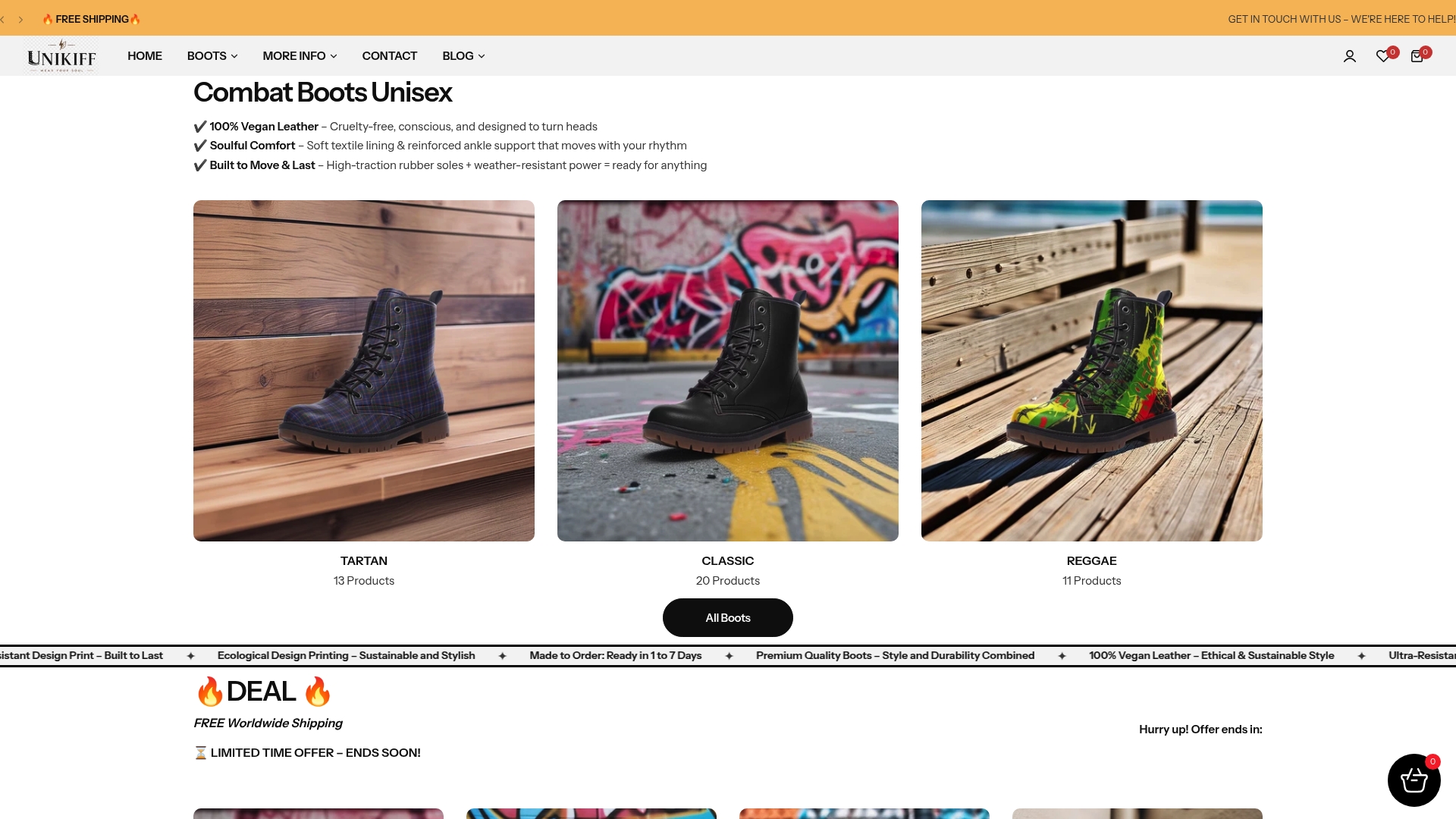
- Browse our full Vegan Combat Boots collection to compare styles side by side.
- Check our size guide before ordering, since correct fit affects how breathable any boot feels in practice.
- Try boots on with moisture-wicking socks if possible, and check product specs for lining details before you buy.
Ready to see the full lineup? Start at Unikiff and find a pair that matches your style and your comfort needs.
FAQ
What are the downsides of vegan leather?
Vegan leather often relies on PU or PVC coatings that reduce breathability and can feel less flexible than natural leather over time. A comparative material study found that none of the alternatives tested fully matched leather’s combination of flexibility, strength, and vapor permeability, so each option involves some tradeoff.
What are the most breathable boots?
Boots with open mesh panels, engineered microfiber synthetics, or breathable membrane systems like AQUAIR® tend to perform best for airflow. The lining matters just as much as the upper, since a wicking liner moves sweat away from your foot toward the outer material.
Is vegan leather breathable?
It depends on the type and finishing process rather than the material being vegan or not. Plant-based leathers like Piñatex offer moderate natural breathability, but polyurethane coatings commonly applied for durability can noticeably cut that airflow.
Are vegan leather boots good?
Vegan leather boots can offer strong everyday comfort and durability when the lining, membrane, and upper are designed to work together rather than relying on the upper material alone. We build our combat boots with reinforced details and supportive structure specifically for daily wear, alongside bold designs for alternative styles.
Sources
- Aquair - Trans-Textil GmbH
- Preparation and Performance of Superfine Fiber Synthetic Leather with High Air and Moisture Permeability
- Comparison of the Technical Performance of Leather, Artificial Leather, and Trendy Alternatives
- Are plant-based leathers (e.g., Piñatex) breathable? - Knowing Fabric