


Vegan combat boots are usually lighter than traditional leather combat boots, but “light” depends on the sole, hardware, and construction. Vegan leather uppers shave real weight off a pair, while thick rubber outsoles and metal eyelets can add it right back. Unikiff builds its combat boots around that balance, aiming for boots that look bold without feeling like bricks on your feet. Here’s what actually determines the weight in your hands.
TL;DR:
- Vegan combat boots are generally 15 to 25% lighter than leather counterparts due to the lower density of synthetic uppers.
- The weight of a pair depends heavily on sole material, hardware, construction method, and lining, with EVA midsoles and glued construction reducing overall weight.
- Lightweight fashion combat boots typically weigh between 1.0 and 1.8 pounds per pair, while tactical versions can exceed 3 pounds due to reinforced materials.
- Perceived weight on the foot is more influenced by fit and weight distribution than raw ounces, making proper sizing and support crucial for comfort.
- Material quality and care significantly impact durability, with lighter synthetics requiring regular maintenance to avoid early wear and cracking.
Table of Contents
- What Makes A Combat-Style Boot Heavy: Materials Vs. Construction
- How Heavy Are Combat Boots, Really? Typical Weight Ranges
- Do Combat Boots Feel Heavier Than They Actually Weigh?
- Durability And Care: Lighter Materials, Different Upkeep
- How To Choose A Cruelty-Free Combat Boot That Balances Weight And Style
- Combat Boots Vs. Work Boots And Hiking Boots: Where They Land On The Scale
- Does Boot Weight Actually Cause Fatigue During Long Wear?
- Advancements In Lightweight Combat Boot Materials
- How Unikiff Designs Boots That Look Bold Without Weighing You Down
- Shop Unikiff’s Cruelty-Free Combat Boot Collections
- Sources
- FAQ
What Makes A Combat-Style Boot Heavy: Materials Vs. Construction
The upper material is the first weight factor, and it’s the one shoppers notice fastest. Vegan and synthetic uppers run 15 to 25% lighter than traditional animal leather, because synthetic microfibers pack less density than tanned hide. That difference shows up the moment you pick up a boot in-store.
Construction method matters just as much as material, though it gets far less attention. Stitched or welted boots (built with a sewn seam connecting the upper to the sole) add weight but can be resoled, so they last longer per pound. Cemented or glued construction is lighter and cheaper to produce, but once the seams wear out, you replace the whole boot rather than repairing it.
Then there’s what’s happening underfoot, which rarely gets a mention on a product page. EVA midsoles are noticeably lighter than polyurethane or solid rubber, and metal shanks (the rigid support strip inside the sole) or heavy-duty eyelets can quietly tack on extra ounces.
Pro Tip: Before buying, scan the product description for these four words: sole material, hardware type, construction method, and lining. If a listing skips all four, that’s usually a sign the brand isn’t paying close attention to weight either.
When you’re comparing options, check for:
- Upper material (vegan leather vs. animal leather)
- Outsole type (EVA, PU, or solid rubber)
- Hardware (eyelets, buckles, shanks)
- Construction (stitched/welted vs. cemented)
How Heavy Are Combat Boots, Really? Typical Weight Ranges
Fashion-focused vegan combat boots typically weigh less than most shoppers expect, especially compared to the tactical boots that dominate search results for “combat boots.” Pair weights for lighter synthetic footwear generally land around 1.0 to 1.8 pounds per pair, while comparable leather pairs run closer to 1.5 to 2.5 pounds. That’s a meaningful gap when you’re wearing boots for a full festival day.
Military and tactical combat boots sit in a completely different category, often reaching 3 to 5+ pounds per pair once you factor in reinforced toes and heavy-duty outsoles built for field conditions. Fashion combat boots aren’t built to that spec, and they don’t need to be.
A few things to check when you’re reading a weight listed on a product page:
- Confirm whether the number is per boot or per pair (double it mentally if it’s per boot).
- Compare against your current daily shoes; sneakers average under a pound per shoe.
- Remember size affects weight, so a men’s size 11 will weigh more than a women’s size 7 in the same style.
Do Combat Boots Feel Heavier Than They Actually Weigh?
Perceived weight and actual weight are two different things, and this is where most shoppers get confused. A boot’s raw ounces matter less than how those ounces sit on your foot. Weight distributed evenly across a balanced sole and supportive ankle collar feels lighter than the same weight concentrated in a stiff toe cap or a clunky heel.
Fit plays a bigger role than most people expect. Vegan uppers tend to be more consistent right out of the box since they don’t stretch and mold the way animal leather does, which means less break-in time but also less forgiveness if you size down. A boot that’s slightly too tight will always feel heavier than one that fits.
Here’s what to test before you commit to a pair:
- Walk a short distance in the boots, not just stand in them.
- Rotate your ankle to check for stiffness at the joint.
- Press on the sole to feel where the flex point sits.
- Check if the tongue and collar pinch when you bend your knee.
Pro Tip: If two boots weigh the same on a scale but one feels lighter on your foot, trust your foot. Weight distribution beats raw ounces almost every time.
Durability And Care: Lighter Materials, Different Upkeep
Lighter usually means a trade-off somewhere, and with vegan combat boots, that trade-off shows up in long-term care rather than day-one comfort. Synthetic uppers are consistently lighter than animal leather, but material quality determines how long that lightness lasts, since cheaper synthetics crack and peel faster than well-engineered vegan leather.
The good news: a little maintenance goes a long way. A few habits keep vegan uppers performing well past their first festival season:
- Wipe down mud and dirt with a damp cloth rather than letting it dry and crack the surface.
- Keep boots away from direct heat sources like radiators or car dashboards, which can warp synthetic materials.
- Check seams periodically for lifting, since that’s usually the first sign of wear.
- Store boots upright with the shape intact instead of tossed flat in a bag.
Our guide to cleaning and maintaining vegan leather boots covers the specifics in more depth. If you wear boots daily for work or long city walking, a stitched construction with a slightly higher weight might outlast a cemented pair. If you’re wearing them for occasional festival outings or outfit days, the lighter cemented build is usually the smarter pick. For a fuller rundown of trade-offs, see our breakdown of vegan leather combat boot pros and cons.
How To Choose A Cruelty-Free Combat Boot That Balances Weight And Style
Your use case should drive your priorities more than any single spec. Someone wearing boots for an eight-hour festival day has different needs than someone pairing them with a work outfit twice a week, and our personal style guide for women offers useful tips on building your best wardrobe to match various occasions.
- Define your primary use. Festival and travel days favor lighter EVA midsoles and grippy rubber outsoles; everyday city wear can handle a slightly heavier, more structured build.
- Check the listed weight and sole material. If a product page doesn’t list either, that’s worth asking about before you buy.
- Look for visible stitching along the welt. It signals a resoleable, more durable build, usually at a small weight premium worth paying for boots you’ll wear often.
- Note the hardware. Metal eyelets and buckles add character and a bit of weight; molded synthetic hardware keeps things lighter.
- Read the care instructions before buying, not after. Some vegan materials need more attention around heat and moisture than others.
- Size carefully. Vegan uppers don’t stretch the way leather does, so check our combat boot size guide instead of assuming your usual size will work.
Comfort compounds over a full day of wear, so don’t skip the break-in period even with a well-fitted pair.
Combat Boots Vs. Work Boots And Hiking Boots: Where They Land On The Scale
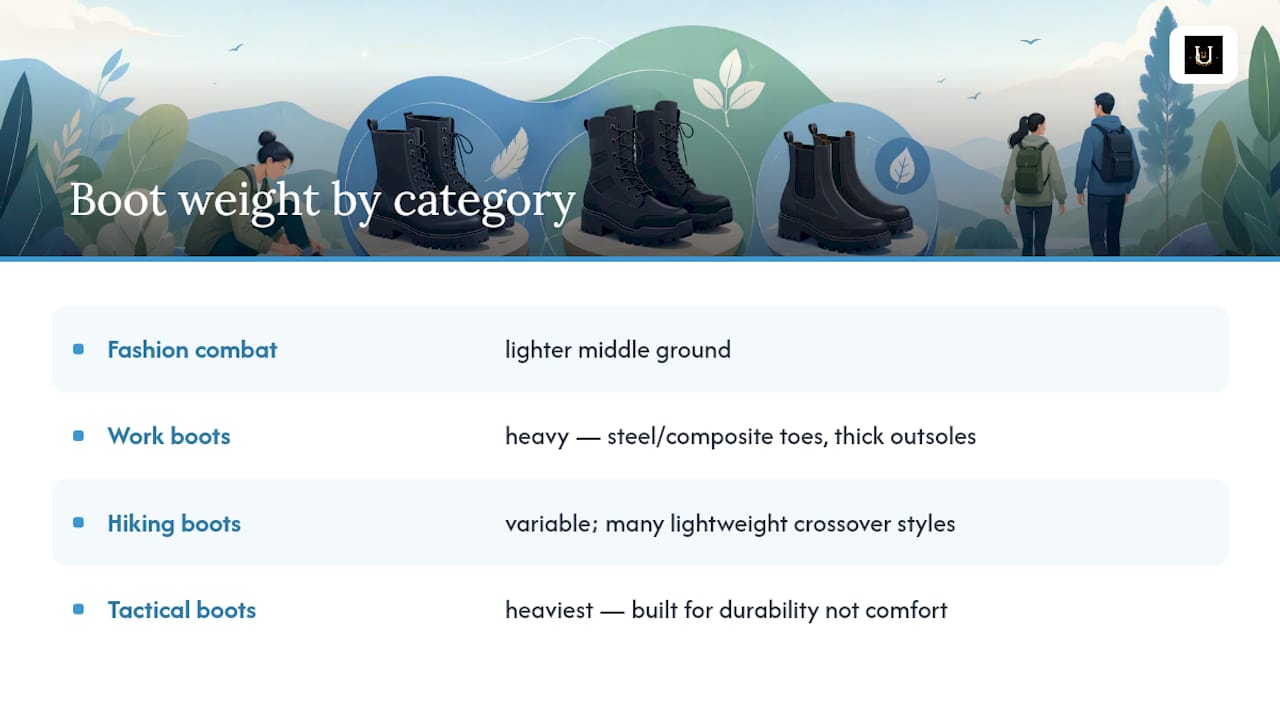
Combat-style fashion boots sit in a lighter middle ground compared to most other boot categories, which helps explain why they’ve become a festival and everyday staple. Work boots, built for job-site protection, typically carry steel or composite toe caps and heavy-duty rubber outsoles designed to survive years of abuse, pushing pair weights well above what a fashion combat boot needs to carry.
Hiking boots occupy a different niche again. Lightweight hiking boots have become a category unto themselves in outdoor gear, with many brands specifically marketing “lightweight combat boots for hiking” crossover styles that borrow ankle support from combat boot design while keeping soles closer to trail-running shoes. That crossover is telling: it shows outsole engineering, not the upper material, is often the biggest single lever for reducing weight across boot categories.
Military and tactical combat boots remain the heaviest of the bunch, built for durability and protection over comfort during long marches. Fashion combat boots borrow the silhouette (the lace-up front, the ankle height, the chunky sole) without inheriting the weight, because they’re solving a different problem: looking sharp for a night out, not surviving field conditions. That’s the gap that trips up a lot of online searches, since generic boot comparisons often lump fashion and tactical boots together when they shouldn’t be.
Does Boot Weight Actually Cause Fatigue During Long Wear?
Every extra ounce on your foot matters more the longer you’re on your feet, and festival days or full shifts of city walking are exactly when that adds up. Foot and leg fatigue builds gradually with heavier footwear, since your muscles work harder with every step to lift and control extra mass at the end of your leg, which is farther from your body’s center of gravity than weight at your hip or waist.
This is part of why the material and construction choices covered earlier aren’t just about how a boot feels in your hand at checkout. A pair that’s a few ounces lighter per boot can translate into noticeably less strain by hour six of a festival lineup or a full retail shift. Combine that with the perceived weight factors from fit and distribution, and you get compounding comfort, or compounding discomfort, depending on how the boot is built.
The practical takeaway: if you know you’ll be on your feet for extended stretches, prioritize both actual weight and distribution over how a boot looks standing still in a mirror. A boot that feels fine for the first twenty minutes can feel very different by the end of a twelve-hour day, which is exactly why the try-on walk test matters more than a quick standing check.
Advancements In Lightweight Combat Boot Materials
Vegan footwear has moved well past the flat, plasticky synthetics that gave early “pleather” boots a bad reputation. Newer plant-based leathers, including corn-based and other bio-based composites, now approach the look and hand-feel of animal leather while keeping the weight advantage that synthetic uppers have always offered.
Outsole technology has advanced just as much as upper materials. EVA compounds have gotten more durable without adding bulk, and brands are increasingly blending EVA cushioning with grippy rubber treads to cut weight without sacrificing traction, a combo that festival-goers in particular tend to gravitate toward for long days on uneven ground.
Hardware is catching up too. Reinforced eyelets and buckles that once required solid metal are now available in lighter alloy blends or molded synthetics that hold their shape without the same weight penalty. None of this makes a combat boot weightless, and it shouldn’t; some structure is what gives these boots their ankle support and their look. But the gap between “lightweight” and “flimsy” has narrowed considerably, which is good news for anyone who wants a boot with presence that doesn’t wear them out by the third hour of standing.
How Unikiff Designs Boots That Look Bold Without Weighing You Down
Every design choice at Unikiff starts with the same question: how do we make a boot that looks unmistakable without punishing your feet for wearing it? That’s harder than it sounds when your whole identity is built on bold prints, gothic details, and statement silhouettes that could easily tip into “heavy costume boot” territory.
The answer shows up in the build. Unikiff’s vegan combat boots pair cruelty-free uppers with high-grip rubber soles, reinforced ankle structure, and lace-up closures designed for everyday wear, not just a few hours at a festival. Reinforced details add durability where boots take the most abuse, without loading up the parts of the boot that don’t need it.
You shouldn’t have to choose between a boot that turns heads and one you can actually wear for twelve hours straight. That tension is exactly what shapes every silhouette Unikiff puts out.
— David
Shop Unikiff’s Cruelty-Free Combat Boot Collections
The brand is an alternative to guessing at weight from a blurry product photo: pairs are built cruelty-free, with the sole material, hardware, and construction details that actually determine how a boot feels by hour eight of wear. Whether you’re drawn to gothic prints, punk graphics, or something closer to cottagecore, you can choose from styles designed to carry their look without carrying extra bulk.
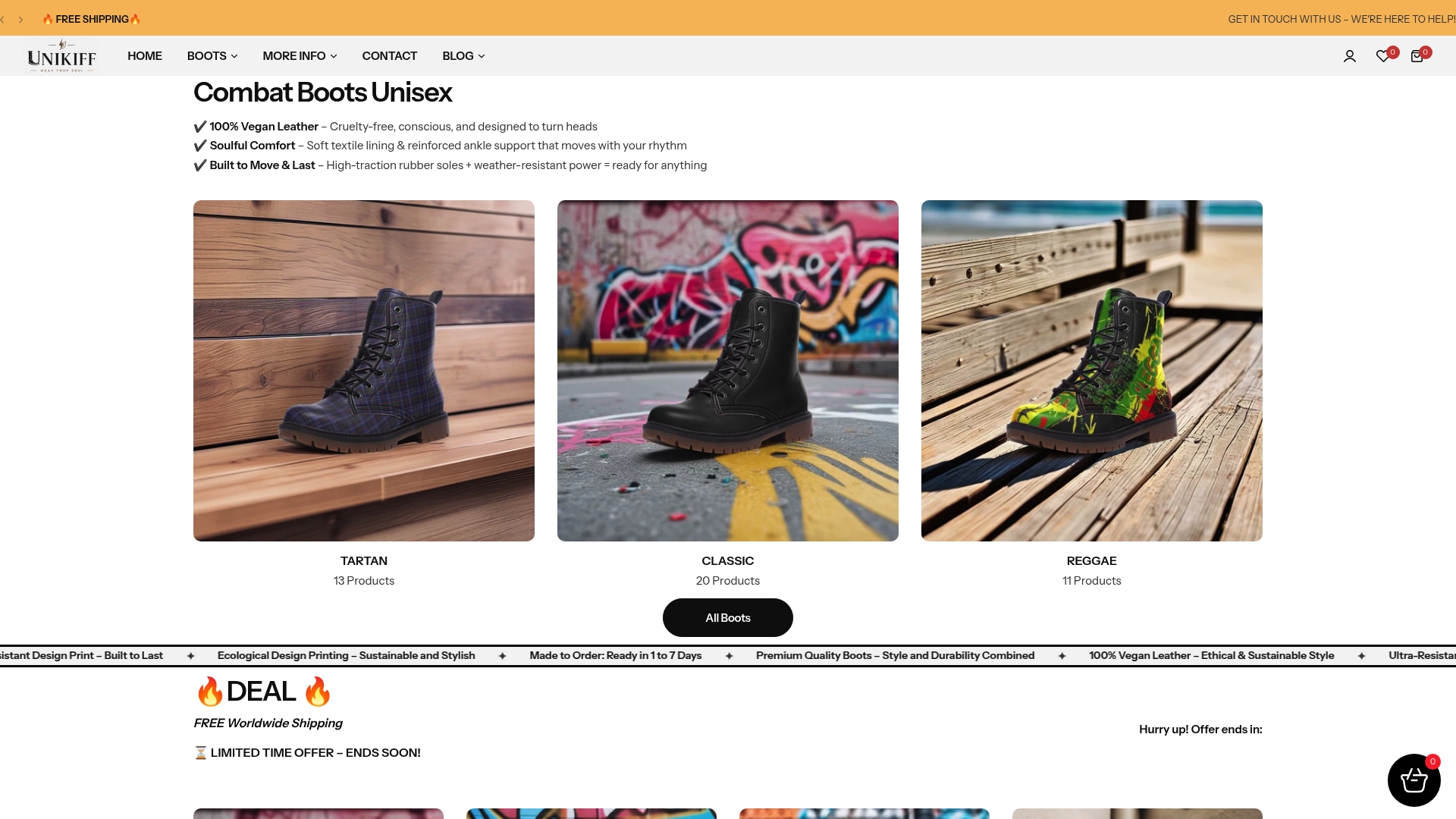
Before you order, run through the specs we’ve covered here: sole type, hardware, and stitching, then confirm your fit with the combat boots size guide so you’re not guessing between half sizes. If punk graphics are your thing, browse the punk combat boots collection; if you lean softer and floral, the cottagecore combat boots line has you covered. For a broader look at every style Unikiff offers, visit the full vegan combat boots collection and find the pair that fits both your outfit and your day.
Sources
- Weight Comparison: Leather vs. Synthetic materials (Perwanger leather FAQ)
- Weight comparison: Sustainable leather shoe vs. non-sustainable (Ansso)
- Synthetic Vs Leather Boots: The Ultimate Showdown! (VersusGuy)
- Combat boots: Find out how much do they weigh! (WisePickers)
FAQ
Are Vegan Combat Boots Heavier Than Leather Combat Boots?
No, vegan combat boots are generally lighter, since synthetic and plant-based uppers run 15 to 25% lighter than animal leather. The exact difference depends on the specific sole and hardware each boot uses.
How Much Do Fashion Combat Boots Typically Weigh Per Pair?
Lighter synthetic pairs generally weigh around 1.0 to 1.8 pounds per pair, noticeably less than the 3 to 5+ pounds common in military-style tactical boots. Fashion combat boots from various brands are built to that lighter end of the spectrum.
Why Do Some Lightweight Boots Still Feel Heavy On Your Feet?
Perceived weight comes from fit and weight distribution as much as actual ounces, so a poorly fitted boot can feel heavier than a slightly heavier one that fits well. Stiff toe caps, tight collars, and uneven sole flex are usually the real culprits.
Are Vegan Combat Boots Comfortable For All-Day Wear?
Yes, when the construction pairs a supportive ankle structure with a flexible, grippy outsole, vegan combat boots hold up well over long days. Boots with EVA midsoles and reinforced ankle support tend to reduce fatigue better than stiff, unstructured alternatives.
Do Lighter Vegan Combat Boots Sacrifice Durability?
Not necessarily, but material quality matters more than the vegan label alone, since some synthetics wear out faster than well-engineered alternatives. Proper care, like avoiding heat exposure and cleaning off dirt promptly, extends the life of lighter uppers considerably.