


Yes, vegan combat boots are good for walking when they pack cushioned insoles, a high-grip rubber outsole, and a snug (not tight) fit around the ankle. That trio matters more than the upper material itself. Before you buy, run through a quick checklist: insole quality, outsole tread, and true-to-size fit. Skip any of those three, and even the coolest boot on the rack will fight you by hour three.
TL;DR:
- Cushioning, outsole grip, and proper fit are crucial because they prevent fatigue and discomfort during long city walks or festival days.
- Vegan combat boots typically require less break-in time and offer water resistance with proper material quality, but sole durability varies by construction.
- Check that boots have removable cushioned insoles, a high-traction outsole, reinforced ankle support, and solid stitching to ensure comfort and longevity.
- Fit properly by measuring both length and width, trying on with your actual socks, and customizing laces to avoid pressure points and blisters.
- Combat boots trap heat and moisture due to their high ankle and closed design, so breathable lining and moisture-wicking socks extend walkability in warm weather.
Table of Contents
- Are Combat Boots Good for Walking? What the Build Actually Tells You
- How Do Vegan Combat Boots Perform for Everyday Walking?
- What Should You Check Before Buying Vegan Combat Boots for Walking?
- How Should Vegan Combat Boots Fit, and How Fast Do They Break In?
- How Do You Care for Vegan Combat Boots and Keep Them Walking-Ready?
- How Do You Style Combat Boots for City Walking Without Losing Comfort?
- Do Combat Boots Breathe Well Enough for Long Walks?
- Combat Boots vs. Hiking Shoes or Walking Shoes: Which Wins for the City?
- Does Walking in Combat Boots Cause More Foot Fatigue?
- Are Combat Boots Warm Enough (or Too Warm) for Everyday Wear?
- Can Prolonged Walking in Combat Boots Cause Foot Problems?
- Why Unikiff Vegan Combat Boots Check Every Box on This List
- Author’s Note: Experience and Practical Takeaway
- Sources
- FAQ
Are Combat Boots Good for Walking? What the Build Actually Tells You
The upper gets all the attention on social media, but the parts that decide whether your feet hate you by the end of the day are hidden underneath it. Cushioning, arch support, outsole grip, and weight distribution do the real work. A boot can look flawless and still wreck a festival weekend if any one of those is missing.
Cushioning and shock absorption. A padded insole and a supportive midsole absorb the repeated impact of concrete, cobblestones, and gravel. Without that layer, every step sends a jolt straight up through your heel and into your lower back.
Arch support and footbed stability. A footbed that holds its shape instead of flattening out keeps your foot from rolling inward with each stride, which is where a lot of end-of-day soreness actually starts.
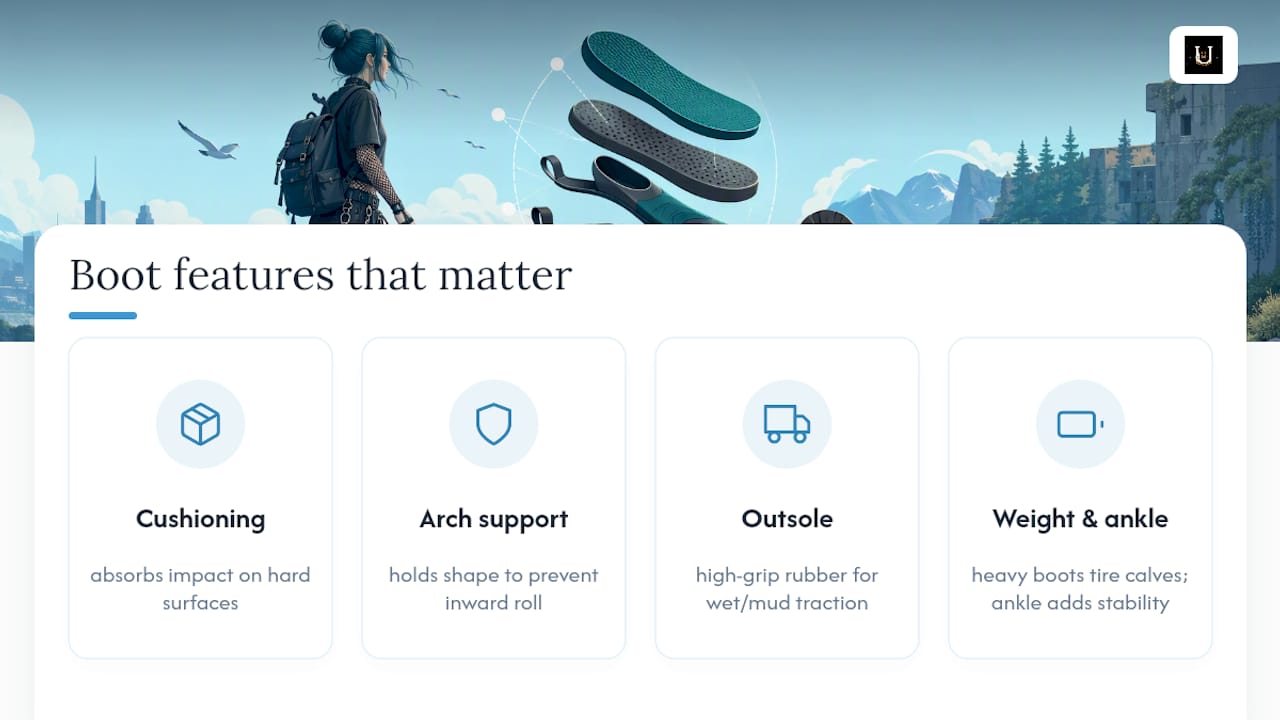
Outsole traction. High-grip rubber grips wet pavement, festival mud, and painted crosswalk lines far better than a hard, glossy sole. It also wears more evenly over time.
Weight and ankle support. A boot that’s too heavy for its own sole tires your calves early. Solid ankle structure, on the other hand, adds stability without adding bulk.
Quick fatigue check: proper foot support, including cushioning and arch support can meaningfully cut down fatigue during long stretches on your feet, which is exactly the situation a full festival day or a packed city itinerary puts you in.
How Do Vegan Combat Boots Perform for Everyday Walking?
Walking in combat boots built from vegan leather tends to feel different from breaking in a stiff cowhide pair, and mostly in your favor. Here’s the real trade-off, pros and cons laid out plainly.
What works in your favor:
- Vegan uppers are often comfortable close to out of the box, with far less of the painful break-in period that leather boots demand.
- Quality vegan leather, especially PU bonded to a dense woven backing, resists water and stains better than untreated leather in a lot of everyday situations, which matters when a festival field turns into mud by noon.
- Lower maintenance overall. No conditioning oils, no waterproofing rituals every other week.
What to watch for:
- Durability swings hard on material grade. Cheap PVC scuffs and cracks faster than premium PU or microfiber.
- Sole construction matters just as much as the upper. Cemented soles are common on vegan combat boots and hold up fine for city and festival use, but they’re rarely as repairable as a traditional welted sole.
- There’s a real weight-versus-stability trade-off: a beefier sole grips better but adds ounces you’ll feel by hour six.
What Should You Check Before Buying Vegan Combat Boots for Walking?
Most comfort problems get caught before checkout, not after. Run through this list on the product page or while trying a pair on in person.
- Removable, cushioned insoles. Look for a footbed that doesn’t collapse flat within a week. If it does, plan to swap it for an aftermarket insole.
- Outsole material and tread depth. High-grip rubber or TPU with visible tread pattern beats a smooth, shiny sole every time on wet sidewalks.
- Ankle support and heel cup. Check the product description for reinforced ankle structure, or press the heel cup with your thumb during a try-on. It should resist, not fold.
- Stitching and construction quality. Reinforced double-stitching and clean seams usually signal a boot built to last, rather than a cheap glued rush job.
- Closure system. Full lace-up styles let you fine-tune fit around your instep, which matters more for walking comfort than most shoppers expect.
- Insole and sock upgrades. A $15 cushioned insole and a pair of thicker walking socks fix more comfort issues than a brand-new boot ever will.
Pro Tip: Bring the socks you actually plan to wear when you try boots on. A half-size mismatch caused by sock thickness is one of the most common (and easiest to avoid) comfort complaints.
How Should Vegan Combat Boots Fit, and How Fast Do They Break In?
Vegan uppers are usually more forgiving here than genuine leather. Because the material has less need for a lengthy break-in period, you get a softer, more flexible feel from day one instead of weeks of blister management.
Still, sizing takes a few extra minutes to get right:
- Measure both length and width. Combat boots run narrow in some brands and wide in others, and foot volume varies more than most people realize.
- Try boots on with the actual socks you’ll wear walking. Thick socks change fit more than half a size in some cases.
- Adjust lacing at the ankle and instep separately for a custom micro-fit, rather than tightening one long lace uniformly.
- Swap in a cushioned insole immediately if the stock one feels thin. It’s the fastest comfort upgrade available.
For anyone unsure between two sizes, Unikiff’s vegan combat boots size guide walks through exact measurements before you commit to a pair.
How Do You Care for Vegan Combat Boots and Keep Them Walking-Ready?
Vegan uppers need less fuss than leather, but “less” doesn’t mean “none.” Wipe PU and microfiber uppers with a damp cloth and mild soap, and apply a vegan-safe waterproofing spray every few months if you’re walking through rain regularly.
- Check outsole tread depth periodically. Once it’s visibly smooth, grip drops fast on wet surfaces.
- Cemented soles aren’t easily replaced, so rotating between two pairs extends the life of each.
- Fix loose stitching the moment you notice it. A small repair now prevents a full seam failure later.
- Use sole protectors on boots you wear constantly for city commuting.
Where vegan combat boots aren’t the right call: long wet hikes through unmarked trail, multi-day trekking with a heavy pack, or industrial jobs requiring safety-rated toe protection. Those situations need purpose-built gear, not fashion-forward footwear, no matter how good the outsole is.
How Do You Style Combat Boots for City Walking Without Losing Comfort?
Function and aesthetic don’t have to fight each other. Pair chunkier, deep-tread soles with denim or wide-leg pants for grip on cobblestones, and save sleeker, lower-profile uppers for dress-and-tights combinations where you’re walking shorter distances.
- Cuff or tuck pant hems above the ankle collar so fabric doesn’t catch on laces mid-stride.
- Layer cushioned crew socks under fishnets or sheer tights for festival days. Nobody sees them, and your feet thank you by 9 p.m.
- Pack a spare pair of insoles in your festival bag. Swapping them midday resets cushioning when the original pair compresses.
A well-broken-in pair earns its place in heavy rotation fast, and comfort at that level is a big part of why combat boots work so well as a daily staple rather than an occasional statement piece.
Do Combat Boots Breathe Well Enough for Long Walks?
Airflow is the one area where combat boots, vegan or otherwise, need honest expectations. The ankle-high silhouette and closed construction that give combat boots their support also trap more heat and moisture than a low-cut sneaker.
That’s manageable with the right habits. Moisture-wicking socks, whether wool blends or synthetic performance fabrics, pull sweat away from your skin instead of letting it sit against a synthetic lining. Rotating two pairs so each one gets a full day to air out between wears also matters more than people assume. Boots that never fully dry between uses build up odor and, over time, degrade the insole faster.
Removable insoles help here too. Pulling them out overnight speeds up drying dramatically compared to leaving a closed boot sealed up in a closet. If you’re walking long festival days in warm weather, look for boots with a breathable textile lining rather than a fully sealed synthetic interior. It’s a small spec most listings mention, and it makes a real difference by hour eight.
Combat Boots vs. Hiking Shoes or Walking Shoes: Which Wins for the City?
These aren’t really competing for the same job, and that’s the point. Hiking shoes and walking shoes are engineered around lightweight cushioning and forward flex, built for covering flat or trail miles efficiently. Combat boots are built around ankle stability and structure first, with walking comfort as a secondary (but very achievable) benefit.
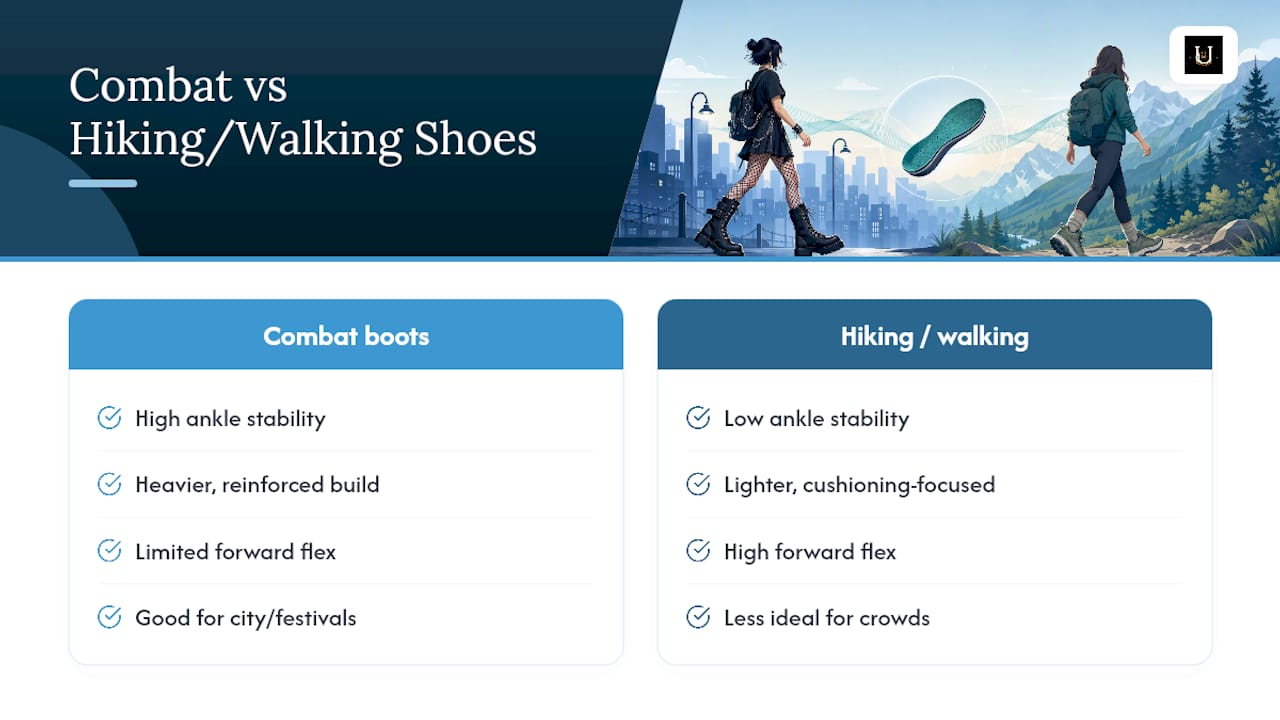
For a city commute, a packed festival ground, or a night out, the ankle support and reinforced build of a combat boot actually work in your favor. Uneven curbs, crowd shuffling, and standing for hours reward the stability a taller boot provides. A low-cut walking shoe offers less twist protection in exactly those conditions.
Where hiking shoes pull ahead is sustained mileage on trail terrain: their lighter builds and more aggressive flex points reduce fatigue over 8 to 10 miles of continuous walking in a way a heavier combat boot generally won’t match. If your day is mostly standing, strolling, and short bursts of walking between locations, a well-built vegan combat boot holds its own. If your day is a genuine hiking trail, it’s the wrong tool for that specific job.
Does Walking in Combat Boots Cause More Foot Fatigue?
It depends almost entirely on the insole and outsole, not the boot category itself. A footbed engineered to absorb impact reduces perceived fatigue on hard surfaces like city sidewalks and pavilion floors, and that principle applies to combat boots exactly as much as it applies to any other shoe.
Where fatigue creeps in is when a boot’s stock insole is thin and flat, forcing your foot to absorb shock the sole should be handling. Add a stiff, heavy build on top of that, and calves and lower backs feel it by the end of a long day. That’s a construction problem, not an inherent flaw in the combat boot silhouette.
The fix is straightforward: prioritize boots with genuine cushioning rather than a decorative footbed, and don’t be afraid to upgrade the stock insole if it feels thin during a try-on. A boot with real shock absorption and a stable heel cup can go a full day of festival walking without the ache that a poorly cushioned pair produces in half the time.
Are Combat Boots Warm Enough (or Too Warm) for Everyday Wear?
Ankle height gives combat boots a genuine edge in cooler weather. That extra coverage blocks wind and holds warmth better than a low-cut sneaker, which makes them a solid pick for fall festivals and winter city walking alike.
Insulation level varies by construction, though. A boot with a thin, single-layer lining stays cool enough for spring and early fall, while one with a quilted or fleece lining pushes into genuine cold-weather territory. Check the lining description before buying if you’re shopping specifically for winter wear; a boot marketed as an all-season staple isn’t automatically insulated.
Warm weather is the flip side of that same coin. The same ankle coverage that blocks cold air also traps heat, so summer festival wear benefits from a boot with a breathable lining and lightweight sole rather than a heavily insulated winter build. Matching the boot’s insulation level to the season you’re actually shopping for prevents both frozen ankles in January and sweaty feet in July.
Can Prolonged Walking in Combat Boots Cause Foot Problems?
Most issues that show up after long stretches in combat boots trace back to fit, not the boot style itself. A boot that’s too tight across the toe box can aggravate bunions or contribute to blisters along pressure points. One that’s too loose lets your heel slide with every step, which creates friction and, over enough miles, real irritation.
Ankle support cuts both ways here too. The structure that stabilizes your ankle on uneven ground is genuinely protective, but a stiff, unbroken-in boot worn for a full day before your feet adjust can leave you with sore Achilles tendons or tight calves. That’s exactly why the break-in and sizing steps covered earlier aren’t optional extras. They’re the difference between a boot that supports your stride and one that fights it.
If you experience persistent pain, numbness, or swelling after walking in any boot, that’s worth mentioning to a podiatrist rather than assuming it’s normal footwear soreness. For routine comfort maintenance, though, a proper pedicure and foot care routine between long walking days, the kind built for genuinely active feet, helps keep calluses and pressure points from turning into bigger problems.
Why Unikiff Vegan Combat Boots Check Every Box on This List
Many boots that meet the checklist feature supportive ankle structure, reinforced stitching, and high-grip rubber soles paired with cushioned footbeds designed for actual walking, not just standing around looking good.
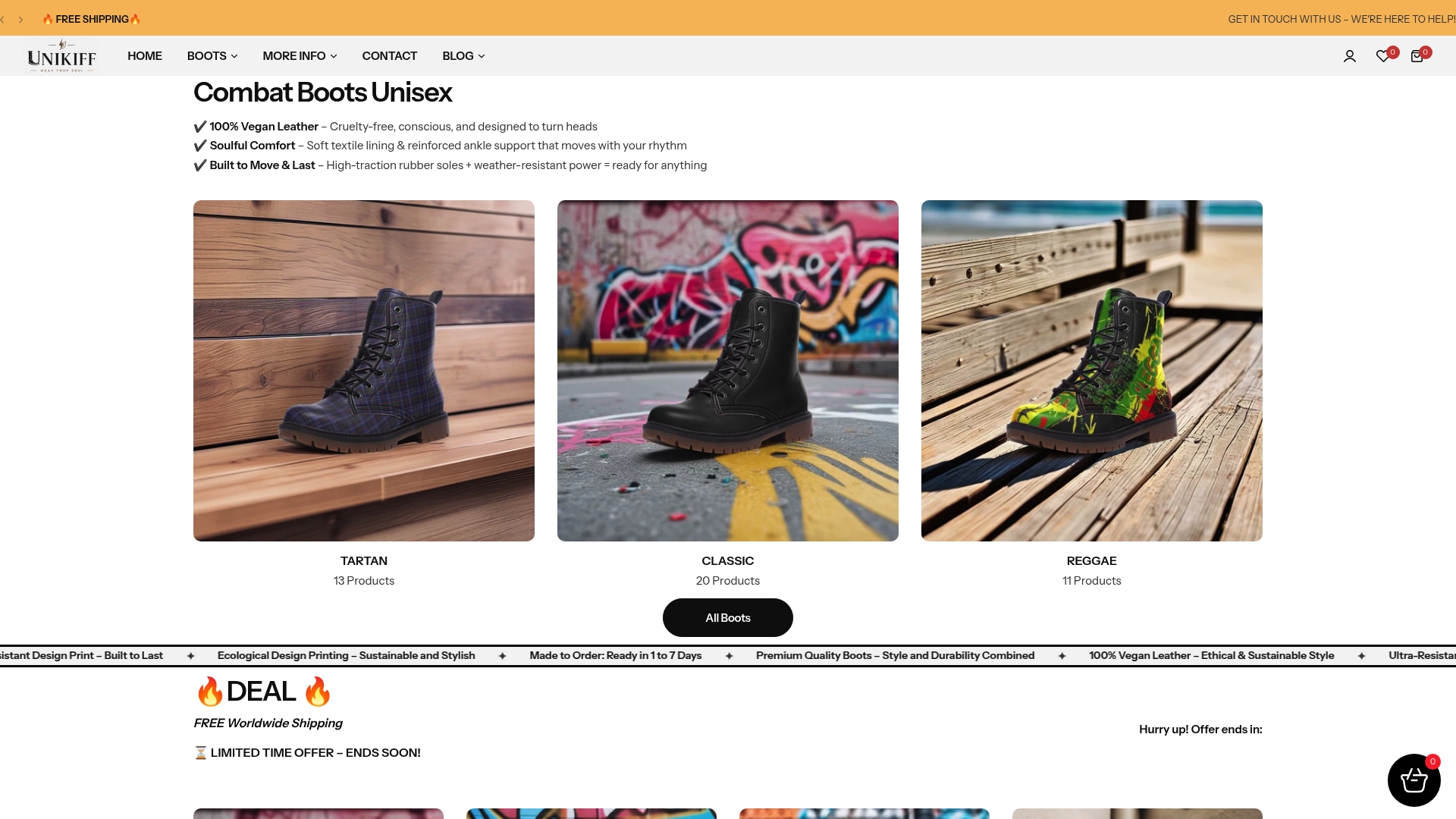
Unikiff’s advantage isn’t just the aesthetic, though the gothic, punk, and cottagecore prints genuinely don’t exist in mass-market stores. If you want a timeless everyday pair, browse the Classic Combat Boots collection. Leaning punk or grunge? The Punk Combat Boots line brings the edge without sacrificing the outsole grip your feet need. Softer, floral, cottagecore energy lives in the Cottagecore Combat Boots collection.
Not sure which size to grab? Check the size guide before you order, then head to Unikiff’s full collection to find the pair that matches your walking day and your wardrobe.
Author’s Note: Experience and Practical Takeaway
The short version: vegan combat boots are good for walking when the insole, outsole, and fit are right, and they’re a genuinely poor fit only for heavy trekking or hazard work… My one piece of advice before any purchase: try the boots on with your actual walking socks and a cushioned insole in place, not the thin stock one.
— David
Sources
- How do I choose the right hiking insoles? — Sidas
- Best vegan leather boots for everyday wear (2026) — SkytitanMedia
- What is vegan leather? Durability, ethics, and the future of footwear — LussoLifestyle
FAQ
Are Combat Boots Good for Walking Long Distances?
They’re solid for city walking, festival days, and standing for hours, especially with a cushioned insole and high-grip outsole. For sustained trail mileage over many miles, a dedicated hiking shoe generally holds up better.
Is Walking in Combat Boots Safe on Wet or Uneven Ground?
Yes, as long as the outsole uses high-grip rubber with real tread depth. Smooth or worn soles lose traction fast on wet pavement, so check tread condition before heading into rainy or uneven conditions.
Do Vegan Combat Boots Need a Break-In Period?
Not much of one. Vegan uppers tend to feel comfortable close to out of the box, unlike stiff leather boots that need weeks of wear to soften.
How Much Do Unikiff Vegan Combat Boots Cost?
Pricing varies by collection and style, so current prices are listed directly on the Unikiff website for each pair.
Are Combat Boots Versatile Enough for Everyday Outfits?
Yes. A well-built pair moves from festival denim to dresses with tights just by swapping socks and adjusting the lacing, which is part of why they’ve become a staple across gothic, punk, grunge, and cottagecore wardrobes alike.